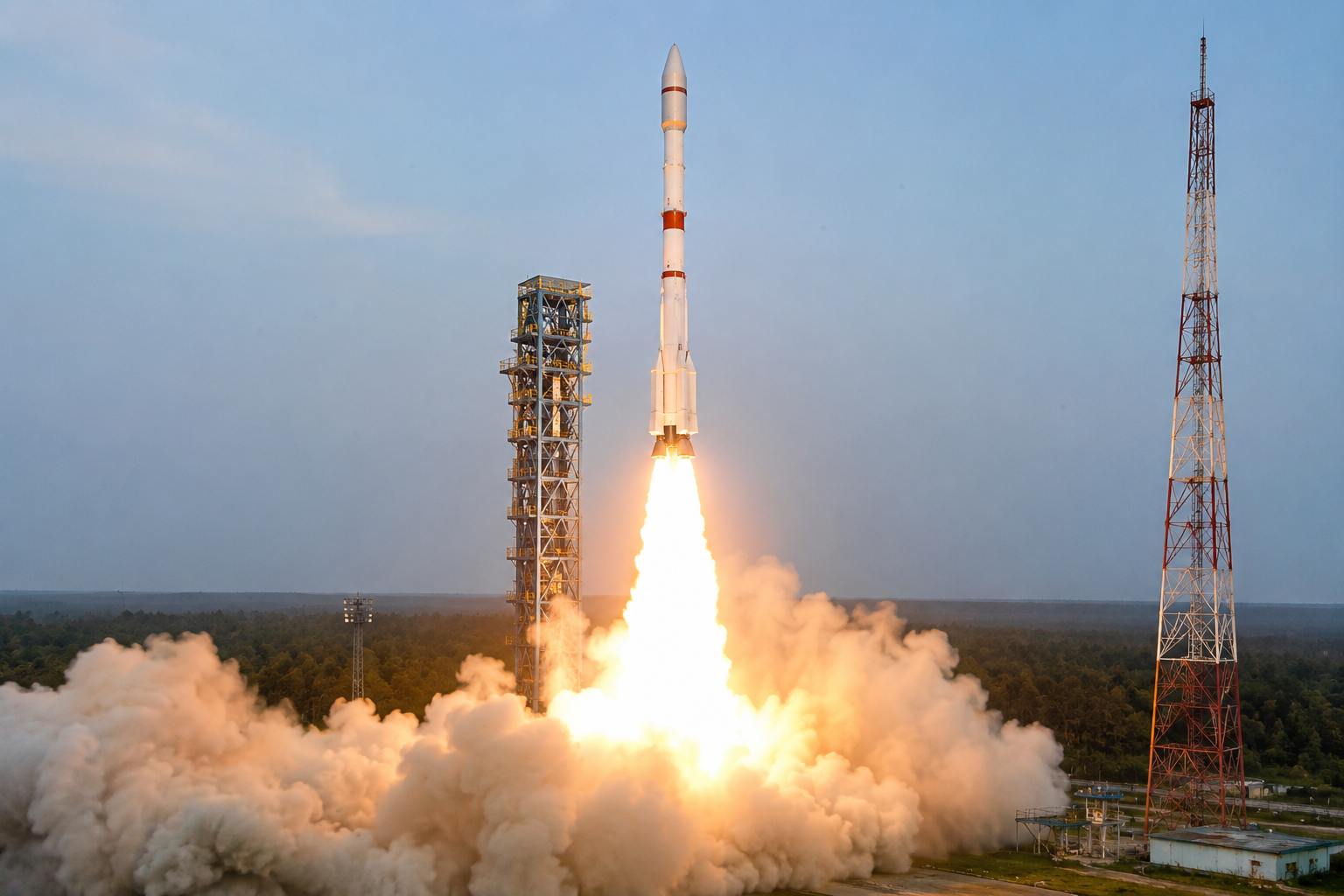
The Indian Space Research Organisation has successfully tested an upgraded first-stage booster for its Small Satellite Launch Vehicle (SSLV), a development that could allow the rocket to carry about 100 kg more payload into low Earth orbit.
The ground static test of the improved SS1 solid booster was conducted on August 11 at the Satish Dhawan Space Centre in Sriharikota, Andhra Pradesh. ISRO said the test performance was close to what engineers had predicted, qualifying the design changes for the first stage.
The improvement has been achieved without adding another stage to the rocket. Engineers increased the propellant burn rate in two motor segments, optimised the thermal protection system and made changes to the nozzle system aimed at improving performance as well as production efficiency. The motor was also made lighter. More than 600 parameters were monitored during the test, covering areas including structural, thermal, dynamic and acoustic performance.
The existing SSLV is designed to place satellites weighing up to 500 kg into a 500-km low Earth orbit. It is a 34-metre-tall, three-stage rocket with three solid-propellant stages and a liquid-propulsion Velocity Trimming Module used during the final phase of a mission.
That additional payload capacity could be useful as India tries to build a stronger position in the growing small-satellite launch market. SSLV was designed around a different model from ISRO’s larger rockets: shorter preparation times, lower infrastructure requirements and the ability to conduct launches when customers need them.
The timing is also important for the rocket’s commercial future. ISRO completed SSLV’s development programme in 2024, and technology transfer to Hindustan Aeronautics Limited (HAL) was signed in September 2025. The vehicle is intended to move towards industrial production and commercial launches.
A dedicated SSLV launch complex is also being developed at Kulasekarapattinam in Tamil Nadu, primarily for polar launches. ISRO says the facility is intended to support the growing demand for small-satellite missions.
The latest booster test is therefore less about making a bigger rocket and more about getting more capability from an existing one. If the upgraded SS1 performs as expected in flight, the roughly 100-kg increase could give SSLV greater flexibility in carrying satellites and strengthen its position as India moves towards a more commercially driven space-launch sector.