

As Odisha and Chhattisgarh explore a settlement after years of legal proceedings, the stakes extend from Hirakud reservoir and dry-season river flows to irrigation, drinking water and the future management of the Mahanadi basin.
The Mahanadi is central to Odisha’s water security. Its waters support agriculture, feed reservoirs, sustain industries and serve communities across the state before the river reaches the Bay of Bengal. The availability of that water influences decisions ranging from irrigation planning to reservoir operations and the management of downstream ecosystems.
Much of the river’s upper basin lies in Chhattisgarh, where the development of barrages and other water-resource projects has become a source of disagreement with Odisha. The downstream state has raised concerns about the cumulative effect of upstream water use on flows reaching Hirakud reservoir, particularly during the drier months. Chhattisgarh has its own requirements for irrigation, drinking water and economic development.
The disagreement has continued through political negotiations, Supreme Court proceedings and years of hearings before the Mahanadi Water Disputes Tribunal. Renewed talks in 2026 have brought the possibility of a negotiated settlement into sharper focus.
On July 30, Union Jal Shakti Minister C. R. Paatil chaired a meeting with Odisha Chief Minister Mohan Charan Majhi and Chhattisgarh Chief Minister Vishnu Deo Sai to advance efforts towards an amicable settlement. A further high-level meeting took place in New Delhi on October 1, chaired by Union Home Minister Amit Shah and attended by both chief ministers and the Union Jal Shakti minister.
The discussions have focused on resolving outstanding technical questions through an expanded committee chaired by the Central Water Commission (CWC) chairman. A hearing before the tribunal was scheduled for October 15 to consider the committee’s work.
For Odisha, the details of any settlement will matter more than the announcement of an agreement. The state needs clarity on water-sharing arrangements, minimum flows, the operation of upstream projects and the safeguards available if the two governments disagree over implementation.
The central question is whether the emerging framework can provide a reliable basis for managing the river while protecting the needs of people who depend on it downstream.
How the Mahanadi Water Dispute began
The Mahanadi originates in the present-day state of Chhattisgarh and flows eastwards through Odisha before entering the Bay of Bengal. Its basin extends across Chhattisgarh, Odisha and smaller portions of Jharkhand, Maharashtra and Madhya Pradesh.
According to the Central Water Commission’s Hydrological Data (Unclassified) Book, 2021, approximately 52.94% of the Mahanadi basin lies in Chhattisgarh and 46.33% in Odisha. The remaining area is distributed among Jharkhand, Maharashtra and Madhya Pradesh.
These figures describe the geographical distribution of the basin. They do not determine the legal share of water available to either state, which depends on the applicable legal framework and the evidence considered in resolving the dispute.
Chhattisgarh became a separate state on November 1, 2000, following its separation from Madhya Pradesh. The Mahanadi crosses the state boundary, making coordination between the two governments essential to its management.
Chhattisgarh has sought to develop its water resources to support agriculture and other economic activities. Odisha, which receives the river downstream, has been concerned about the effect of upstream storage, diversion and withdrawals on the water reaching its territory.
The two states have also differed over the arrangements needed to manage the shared river. An agreement dating to 1983 and proposals for a joint control mechanism have formed part of the wider discussion about cooperation in the basin.
The immediate Mahanadi Water Dispute intensified in 2016, when Odisha raised objections to several barrages and water-resource projects in Chhattisgarh. Among the structures identified in Odisha’s legal proceedings were Kalma, Saradih, Sheorinarayan, Basantpur, Mirouni and Samoda.
Odisha argued that the cumulative effect of upstream projects could reduce the water reaching Hirakud and downstream areas, especially during the non-monsoon period. The state sought intervention by the Union Government and eventually approached the Supreme Court for formal adjudication.
The disagreement raised several connected questions: how much water is available in the river, how much is being stored or withdrawn upstream, how those activities affect downstream flows and what rules should govern the use of a river shared by two states.
Those questions remain central to the negotiations.
From Odisha’s complaint to the tribunal
On November 19, 2016, Odisha submitted a formal complaint to the Union Government under the Inter-State River Water Disputes Act, 1956.
The complaint raised questions about the minimum flow required at Hirakud, surplus flows and the respective shares of the states in minimum and surplus water. Odisha also questioned the extent of water utilisation associated with existing, ongoing and future projects in Chhattisgarh.
In January 2017, the Union Government established a negotiation committee to explore a settlement. The committee included representatives from the basin states and relevant central institutions. Its report was submitted in June 2017, but negotiations did not produce an agreement acceptable to both sides.
Odisha subsequently pursued legal action in the Supreme Court, seeking the constitution of a tribunal to resolve the dispute.
On January 23, 2018, the Supreme Court directed the Central Government to constitute a water disputes tribunal. The Mahanadi Water Disputes Tribunal was established on March 12, 2018, under the 1956 Act. The dispute was formally referred to it in April that year.
The tribunal provided a legal forum in which both states could present their claims, technical evidence and arguments concerning water sharing. The proceedings also brought the dispute within a formal framework for adjudicating the competing claims.
The case has taken years because the questions extend beyond individual barrages. The states must establish the amount of water available in the basin, examine historical flows and existing use, assess future requirements and determine the effect of water-resource projects across the river system.
The tribunal’s work has also been affected by procedural delays. The COVID-19 period interrupted its functioning, and the resignation of its then chairman, Justice A. M. Khanwilkar, in March 2024 created a further period without a functioning quorum until a new chairperson was appointed.
In April 2026, the Central Government extended the tribunal’s deadline for submitting its report and decision until January 13, 2027, or until the report is submitted, whichever is earlier.
The extension provides additional time for the legal proceedings while the states pursue negotiations. A settlement could help resolve outstanding issues, but its terms and legal status must be clearly established in relation to the tribunal process.
Why dry-season flows matter to Odisha
The amount of water flowing through the Mahanadi changes throughout the year. Monsoon rainfall can produce substantial flows, while the months outside the rainy season bring different hydrological conditions.
For Odisha, the availability of water during the drier months is a major concern. Reservoirs, irrigation networks and downstream users must operate within the water available at particular times of the year. Annual totals alone cannot show whether those requirements can be met reliably.
One of the central technical questions in the current negotiations concerns whether flows between November and May can be characterised as minimum non-monsoon flow under the hydrological conditions of the Mahanadi, as Odisha argues.
The classification could influence how minimum-flow requirements are defined and how water availability is assessed during the drier months.
A workable arrangement needs to specify the period covered, the locations at which flows will be measured, the historical data used to establish the requirement and the method for assessing compliance. It must also account for variations in rainfall and river conditions between years.
The technical assessment should establish how the proposed approach would affect water reaching Hirakud and the requirements of downstream users. It should explain how the states would respond during unusually dry periods, when water demand can exceed what the river and its reservoirs can reliably supply.
For Odisha, a clear definition of minimum flow would help establish a common basis for planning and monitoring. Without agreed measurement procedures, the two states could continue to disagree over whether a particular flow meets the required standard.
Hirakud reservoir and downstream water security
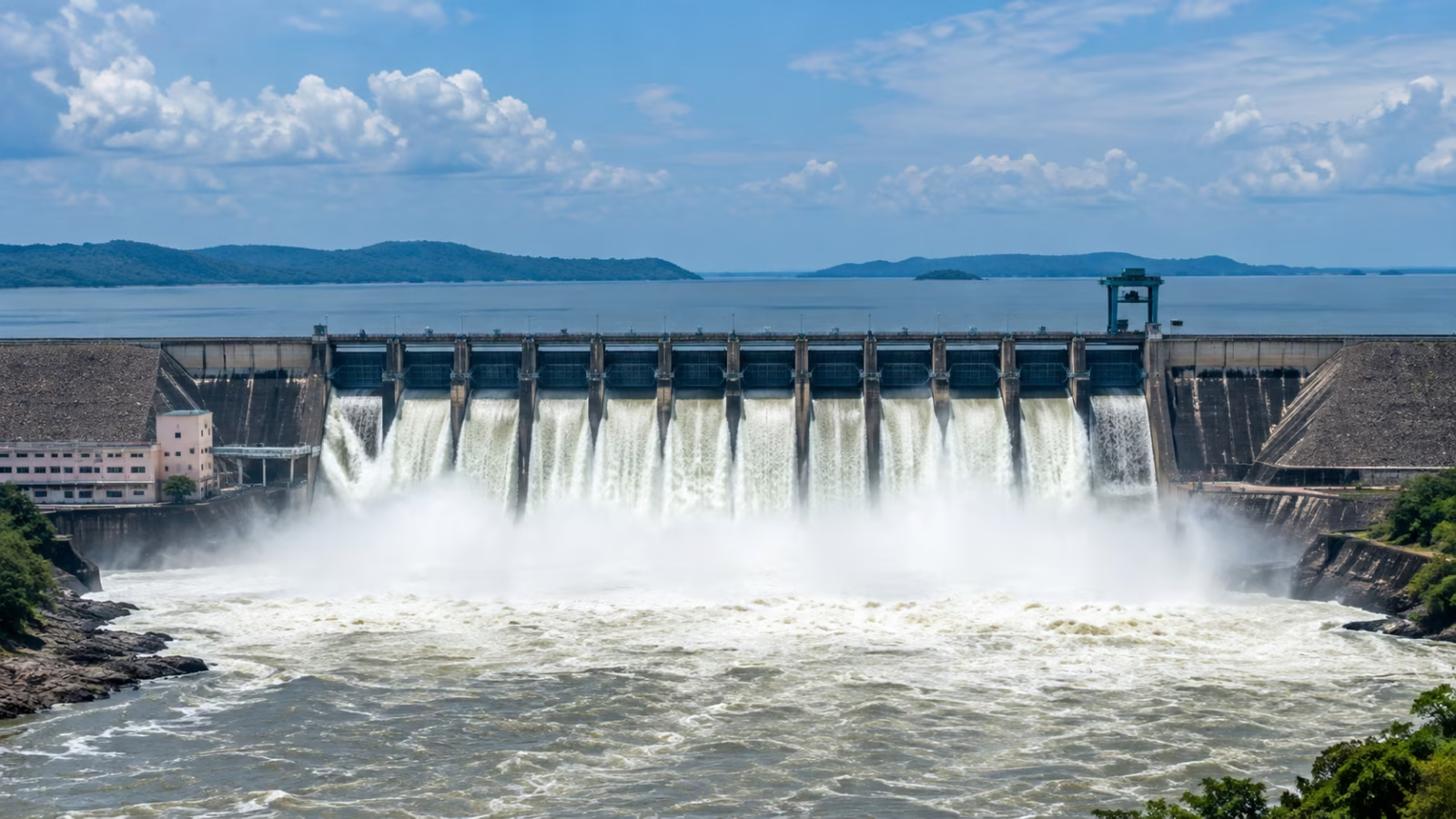
Hirakud reservoir is one of Odisha’s major water-resource assets. It supports irrigation, electricity generation, flood management and other uses. Water entering the reservoir influences how its storage and releases can be managed against competing requirements.
The relationship between upstream flows and reservoir operations is therefore central to Odisha’s concerns.
The volume of water entering Hirakud depends on rainfall, natural river flows, upstream storage and withdrawals, and the timing of releases. Reservoir storage and operating decisions also influence how incoming water is distributed across different uses.
To assess the effects of Chhattisgarh’s projects, the states need a reliable record of flows and water use over time. That record should help identify the effects of individual structures alongside broader changes in rainfall, demand and river conditions.
Odisha also needs to understand how its requirements will be met under different hydrological scenarios. A settlement should clarify how water availability will be assessed, how relevant upstream operations will be monitored and what procedure will apply when the states disagree about the data.
Such arrangements would help Odisha plan irrigation and reservoir operations with greater certainty. They would also provide a common technical basis for addressing concerns before they develop into another prolonged legal confrontation.
The Kalma barrage question
Kalma barrage has become a prominent issue in the latest phase of the dispute.
Ahead of the October 15 tribunal hearing, reports identified a question concerning Chhattisgarh’s right to draw water from the storage of Hirakud reservoir through Kalma barrage, which is situated in the reservoir’s foreshore area.
The issue connects the operation of an upstream structure with the management of a major reservoir in Odisha. Resolving it requires clarity on the barrage’s location, operating arrangements, the volume and timing of water drawn, and the legal basis for those operations.
The states also need to establish how the relevant operations affect water availability at Hirakud and downstream. That assessment requires technical evidence about river flows, storage and withdrawals.
A settlement should define the rules governing the relevant operations, identify the information that must be shared and establish a procedure for monitoring compliance.
If the Kalma question remains unresolved while other parts of the dispute are settled, it could continue to generate disagreement. Its treatment in any final framework will therefore be important to the wider effort to establish predictable water-management rules.
Chhattisgarh’s position: Development and water requirements
Chhattisgarh’s position reflects its own requirements for water and development. The state needs supplies for agriculture, drinking water, industry and public infrastructure. It has pursued water-resource projects to support those needs and has argued for a cooperative approach to managing the shared river.
Those requirements deserve consideration in a settlement. A shared river must serve communities across the basin, and the states need rules that account for existing use as well as future demand.
The question is how those requirements should be balanced against Odisha’s dependence on downstream flows.
Chhattisgarh’s position in the upper basin gives it a major role in decisions about storage, diversion and water use before the river enters Odisha. This makes coordination particularly important. Decisions taken upstream can influence the water available farther downstream, while the requirements of the upstream population also need to be considered in the overall allocation.
The technical record should establish the amount of water available in the basin, the existing and proposed uses, the effects of relevant projects and the requirements of each state. It should also account for the cumulative effect of infrastructure rather than treating each barrage or reservoir as an isolated project.
The final framework should be based on common data and clearly defined responsibilities. It should explain how the states will share information, assess the impact of future projects and resolve objections before they develop into another prolonged dispute.
Understanding Chhattisgarh’s documented position is essential to negotiating terms that can be implemented. The agreement must account for both states’ requirements while establishing clear expectations for water sharing and reservoir operations.
The Centre’s role in the Mahanadi Water Dispute settlement process
The Union Government has been involved in the Mahanadi Water Dispute since Odisha first sought intervention in 2016. Its role has included facilitating negotiations, constituting the tribunal and supporting technical consultations.
On July 30, 2026, Union Jal Shakti Minister C. R. Paatil chaired a meeting with Odisha Chief Minister Mohan Charan Majhi and Chhattisgarh Chief Minister Vishnu Deo Sai. Senior officials from the Ministry, the Central Water Commission and both state governments also attended.
The Ministry said the meeting marked progress in efforts to resolve the dispute through dialogue and technical cooperation. It also noted that a joint technical committee had reached agreement on several issues and that an expanded committee, chaired by the CWC chairman, had been formed to address the remaining technical questions.
The expanded committee began its work at the end of July. Its task included examining outstanding technical issues and helping the states establish a common basis for further discussions.
A further high-level meeting took place in New Delhi on October 1 under Union Home Minister Amit Shah. Both chief ministers and the Union Jal Shakti minister participated as discussions continued on a possible settlement.
The CWC’s involvement is significant because water sharing depends on a reliable technical understanding of the river. Its role in the committee provides a forum for examining data, discussing competing interpretations and identifying the issues that remain unresolved.
The Ministry of Jal Shakti facilitates the process, while the legal status of any settlement must be considered in relation to the ongoing tribunal proceedings. Negotiations can help the states reach a common understanding, but the terms and procedures required to formalise an agreement must be clearly established.
The Centre’s involvement offers an opportunity to resolve technical disagreements and develop a more predictable system for managing the river. The quality of the outcome will depend on the evidence considered, the clarity of the proposed rules and the commitments accepted by both governments.
Political concerns over transparency
The negotiations have also become a subject of political debate in Odisha.
The Biju Janata Dal has questioned the transparency of the settlement process and called for greater public discussion of the state government’s position. Its representatives have argued that Odisha’s interests must be protected and sought disclosure of the details being discussed by the two governments.
The state government has maintained that it is pursuing a resolution that safeguards Odisha’s interests. Chief Minister Mohan Charan Majhi has presented the talks as an effort to resolve the long-running dispute through legal, administrative and political channels.
The disagreement raises a wider question about how a major inter-state water agreement should be scrutinised when its consequences may extend for decades.
Water-sharing arrangements can establish obligations that future governments will have to implement, even as water demand and hydrological conditions change. Farmers, communities, industries and public institutions all have an interest in understanding the commitments being made.
Political criticism alone cannot establish whether a proposed agreement protects Odisha. The government’s assurances also need to be assessed against the actual terms, the technical evidence and the safeguards included in the settlement.
The government should explain the basis for its negotiating position and make the essential terms available for informed discussion, subject to legitimate legal constraints. Public scrutiny would help citizens understand what has been agreed, what remains unresolved and how the state intends to protect downstream requirements.
The focus should remain on the substance of the agreement and its implications for Odisha’s people.
What Odisha should secure in the final agreement
The settlement will need to establish more than a broad understanding between the two governments. It should provide clear rules for managing water, sharing information and resolving disagreements.
Clear and measurable water-sharing rules
The agreement should explain how water availability will be assessed and how the requirements of the states will be considered. It should define minimum-flow requirements, clarify the treatment of surplus water and specify the periods and locations used for measurement.
Any allocation or flow requirement must rest on sound hydrological evidence. The wording should be precise enough that both states can determine whether their obligations have been met.
Protection during dry-season conditions
The framework should explain how the states will respond when rainfall is weak and river flows decline. It should establish how low-flow conditions are identified, how available water is assessed and what procedures apply when competing requirements cannot all be met as planned.
Such provisions should account for variations between years and the limits imposed by actual water availability. A transparent process would help reduce uncertainty for reservoir managers, irrigation authorities and downstream users.
Shared data and independent monitoring
Both states need access to reliable information about rainfall, river discharge, reservoir storage, withdrawals and project operations.
The agreement should establish common measurement procedures, regular reporting and a mechanism for examining disagreements over the data. Monitoring stations and periodic technical reviews could help the states work from the same evidence.
The public should also receive meaningful updates on implementation, allowing people to understand how the arrangement is working over time.
Rules governing upstream projects
The agreement should set out procedures for sharing information about relevant water-resource projects and assessing their cumulative effects.
It should clarify what technical information must be provided, how objections will be examined and how disputes over project operations will be handled. These provisions would give both states a clearer process for addressing future concerns before they develop into another prolonged legal battle.
Safeguards for downstream communities
Odisha’s water requirements extend across drinking water, agriculture, industry and environmental needs. The agreement should consider these uses and explain how they will be managed during periods of lower availability.
For farmers, the practical value of a settlement will depend partly on whether it supports more dependable irrigation planning. For towns and villages, reliable supplies matter to domestic needs. River and delta ecosystems also depend on water flows, although the relevant environmental requirements must be assessed through appropriate scientific evidence.
A settlement should explain how these needs have been considered and how changes in water availability will be addressed.
A mechanism for resolving future disputes
Even a detailed agreement may encounter disagreements over its interpretation or implementation. The states should establish a defined process for technical review, addressing complaints and resolving persistent differences.
The legal status of the settlement and its relationship with the tribunal proceedings should be clear. The responsibilities of each state should be identifiable, and the procedures for addressing non-compliance should be specified.
Periodic review as conditions change
Water demand, infrastructure and rainfall patterns may change over time. The agreement should include a mechanism for reviewing relevant data and assessing whether its operating arrangements remain workable.
Any review process must preserve the legal obligations of the states while allowing evidence-based adjustments through an agreed procedure. This would help the framework remain useful as conditions evolve.
What the October 15 hearing could clarify
The tribunal hearing scheduled for October 15 was expected to consider the report of the expanded technical committee, which had been examining the unresolved questions between the states.
The issues identified ahead of the hearing included whether flows between November and May could be characterised as minimum non-monsoon flow under the hydrological conditions of the Mahanadi, as Odisha argues, and the question concerning Chhattisgarh’s right to draw water through Kalma barrage from the foreshore area of Hirakud reservoir.
The hearing represents an important stage in the process because the committee’s work may help clarify the remaining disagreements. The legal and practical consequences depend on what the committee submitted, what the tribunal considered and what directions or orders followed.
The hearing’s outcome must be confirmed from the tribunal record or a reliable report published after the proceedings before the status of the dispute can be described conclusively. Until then, it would be premature to claim that the technical disagreements have been resolved or that a final settlement has been reached.
The long-term stakes for Odisha
The Mahanadi water dispute has exposed the difficulty of managing a shared river when two states have different water requirements and competing interpretations of their rights. Years of legal proceedings have not removed the need for a practical arrangement that can guide decisions across the basin.
For Odisha, the stakes extend from Hirakud reservoir to the irrigation systems, towns and downstream communities that rely on the river. A settlement needs to give the state a clear basis for assessing incoming flows, planning water use and addressing concerns about upstream operations.
Chhattisgarh’s requirements must also be considered within a framework that recognises the shared nature of the river. The Central Government and the CWC can help the states resolve technical differences, while the tribunal provides the formal legal process for adjudication.
The immediate priority is to establish clear terms on minimum flows, the Kalma barrage question, data sharing and the management of future projects. Those provisions should be supported by transparent monitoring and a credible process for resolving disagreements.
For people in Odisha, the eventual measure will be whether the settlement improves the predictability of water management and protects essential downstream needs. That outcome will depend on the agreement’s actual provisions and the willingness of both states to implement them consistently.
The Mahanadi’s future requires reliable data, clear responsibilities and rules that remain workable when rainfall changes, demand increases and governments change. Odisha’s interests will be best protected by a settlement that translates its concerns into measurable commitments and provides a lasting basis for cooperation across the river basin.