


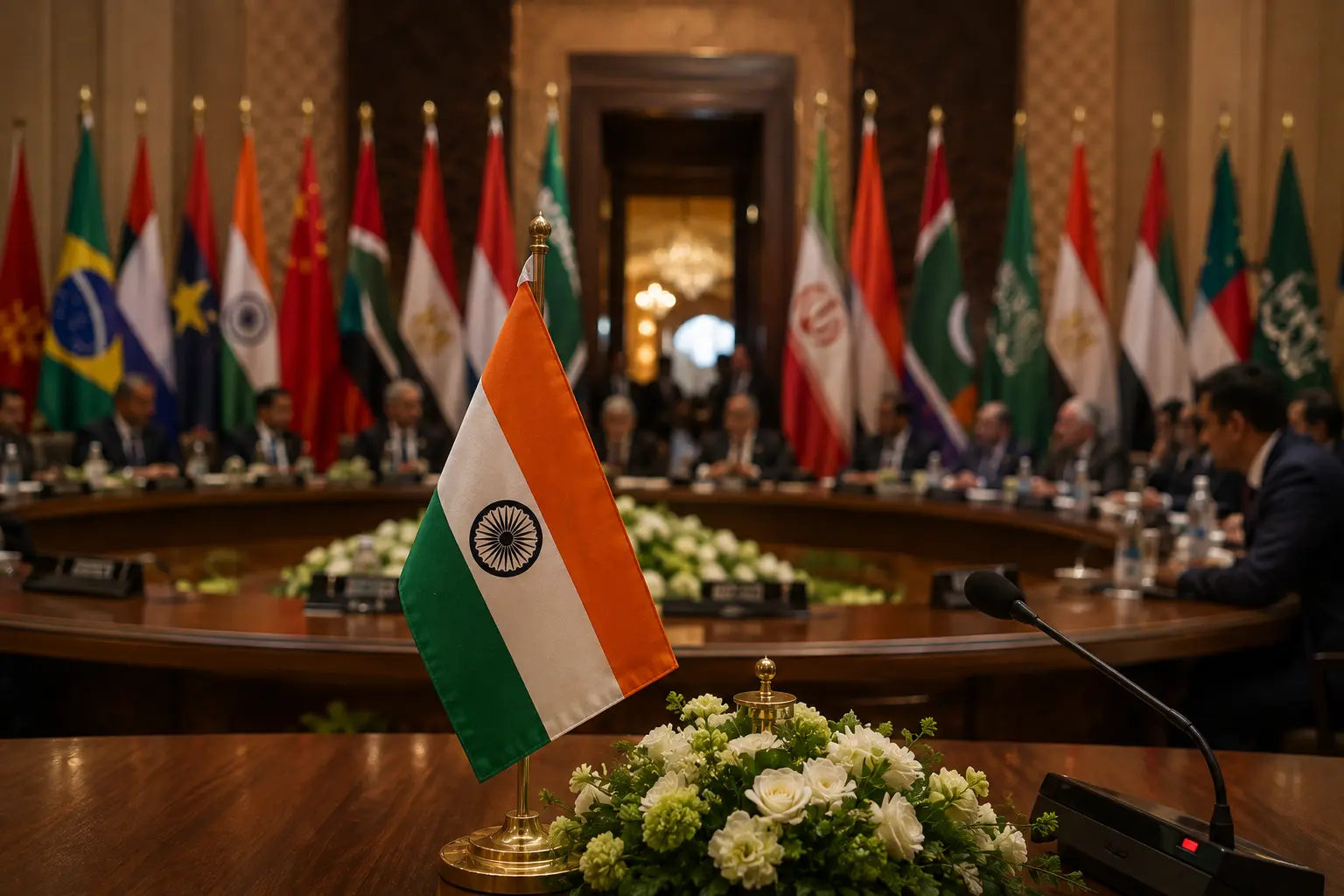
New Delhi, India: India is preparing to host the 18th BRICS Summit in September, bringing leaders of the expanded grouping to New Delhi at a moment when trade, energy security and geopolitical tensions are reshaping relations between major powers.
The summit is scheduled for September 12–13, with India holding the BRICS chairmanship in 2026. The official BRICS programme lists the New Delhi leaders’ summit as the culmination of India’s year-long presidency.
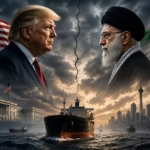
The meeting comes against a difficult international backdrop. The war involving the United States and Iran has disrupted energy markets and reduced shipping through the Strait of Hormuz, one of the world’s most important routes for oil transportation. The United States has also announced plans for what it calls its toughest sanctions yet against Iran, while Tehran has threatened a strong response.
That crisis gives the BRICS meeting an importance beyond its formal agenda.
Iran is now a full member of the grouping, alongside India, China, Russia, Brazil, South Africa and other emerging economies. Iranian President Masoud Pezeshkian is expected to travel to New Delhi for the summit, according to Indian reports, bringing the Middle East crisis directly into discussions among the BRICS countries.
Energy is likely to be one of the most immediate concerns. China, the largest buyer of Iranian oil, is already facing disruptions caused by the US blockade and reduced shipping through Hormuz. Reuters reported on Friday that Iranian oil offers to Chinese buyers had fallen sharply as supplies tightened.
India will therefore be hosting the summit while balancing several interests at once. New Delhi maintains close strategic ties with Washington but also has long-standing relationships with Russia, Iran and other BRICS members.
The grouping itself has changed considerably since it was created. Its expansion has brought in countries from the Middle East, Africa and Asia, giving BRICS a broader geographical and economic footprint. India has repeatedly presented the grouping as a platform for cooperation among developing and emerging economies rather than as an alliance directed against the West.
The summit could also bring economic questions to the forefront. BRICS members are discussing greater trade cooperation, financial coordination and mechanisms that could reduce dependence on existing Western-dominated systems. One proposal under discussion is a BRICS grain exchange aimed at making agricultural trade among member countries more integrated.
For India, the Delhi summit will be an opportunity to demonstrate how it manages relationships with countries that often disagree sharply with one another.
The challenge will be to keep the group focused on practical cooperation while navigating conflicts that increasingly divide its members.
When the leaders arrive in New Delhi next month, the summit will therefore be about more than BRICS itself. It will also offer a picture of how countries outside the traditional Western alliance system are trying to respond to a world where geopolitical and economic uncertainty are becoming increasingly difficult to separate.