





ISRO is facing an unusual question from within its own workforce after nine employee associations asked the space agency’s top leadership to clarify how much of its traditional work could eventually move to private companies.
The associations sent their representation to ISRO Chairman V Narayanan on September 4. They raised concerns over recent statements about private companies and public-sector firms taking up the manufacturing of launch vehicles and satellites, and sought clarity on what that would mean for ISRO and its employees.
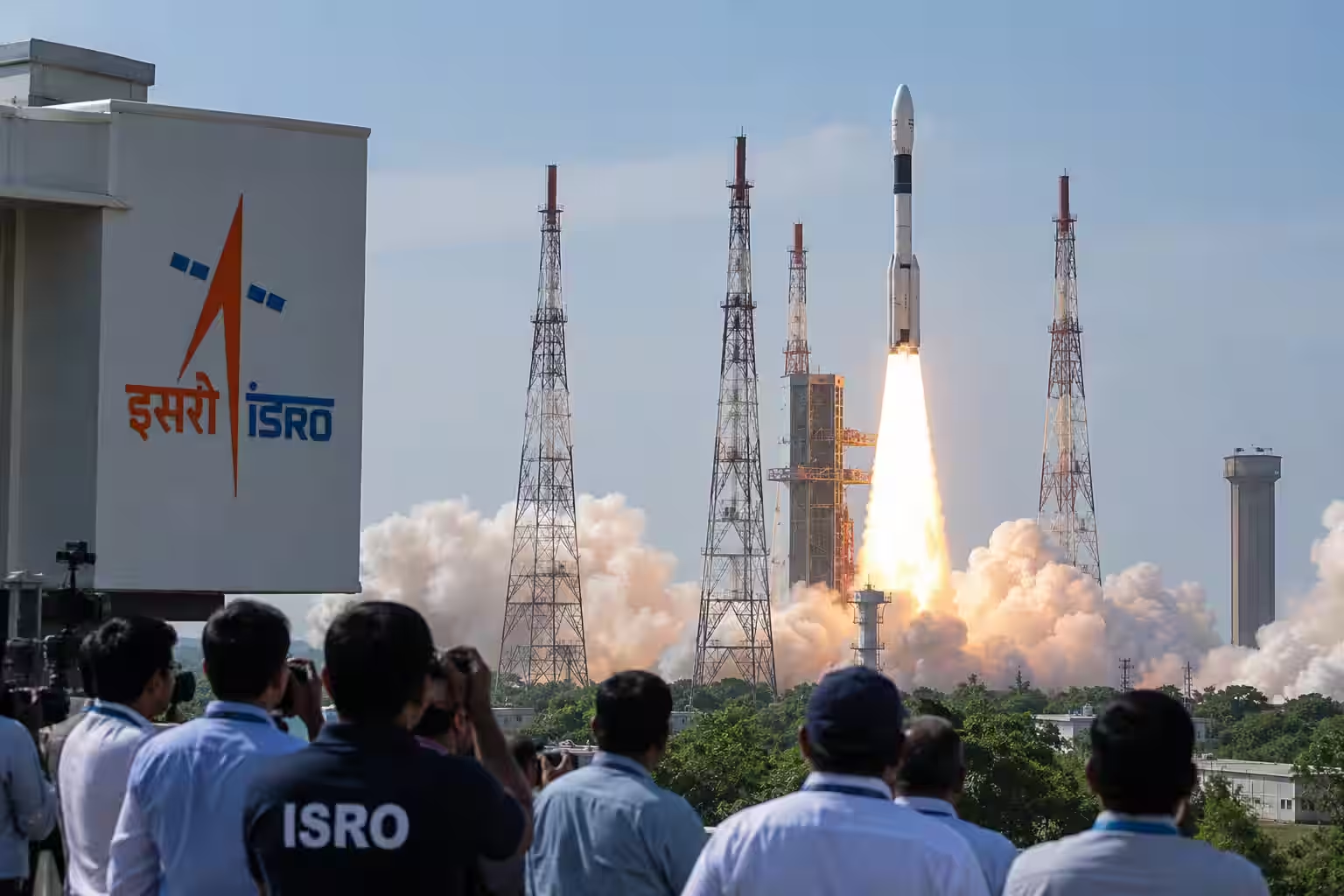
The timing of the letter was notable. It came on the same day ISRO successfully launched the GSLV-F17 carrying the EOS-05 satellite from Sriharikota. The successful mission highlighted the agency’s continuing role in building and launching India’s spacecraft, while the employee associations were asking how that role could change in the years ahead.
The employees are not opposing private participation in the space sector. Their concern is about where the line will eventually be drawn between ISRO and industry.
The issue gained attention after IN-SPACe Chairman Pawan Kumar Goenka said ISRO would eventually stop manufacturing launch vehicles and routine satellites, with such work moving to private companies and public-sector undertakings. The employee associations have sought clarity on whether this represents an approved policy direction and what the proposed transition would mean for the organisation.
Several major ISRO centres are represented by the associations, including the Vikram Sarabhai Space Centre, Satish Dhawan Space Centre, U R Rao Satellite Centre, Liquid Propulsion Systems Centre and Space Applications Centre.
For the employees, the concern goes beyond the question of who will assemble a rocket. ISRO has spent decades developing the engineering and technical expertise needed to design, test, integrate and launch its vehicles. Much of that experience has been built through years of missions, including failures and redesigns that eventually helped make India’s launch programme more reliable.
The associations want to know how much of that capability will continue to remain within ISRO as more work moves to industry.
India’s space sector has already been moving in that direction since the reforms announced in 2020. The government opened more areas of space activity to private companies and created IN-SPACe to facilitate and regulate their participation. NewSpace India Limited has also taken on a larger commercial role.
The change is no longer just a policy announcement. Technology transfer to industry has already begun.
ISRO, NSIL and IN-SPACe signed an agreement with Hindustan Aeronautics Limited in 2025 for the transfer of technology for the Small Satellite Launch Vehicle. ISRO has also said that committees have been formed to examine the transfer of PSLV and LVM3 technology to Indian industry.
That has made the question of ISRO’s future role more immediate for its employees.
The associations have raised concerns about recruitment, promotions and career opportunities as more operational work moves outside the organisation. Government figures show that ISRO had 15,529 employees in position against 18,142 sanctioned posts as of February 2026.
The concern is not that every one of those vacant posts will disappear. Rather, the employees want to know how future staffing decisions will be made if some of the work currently performed inside ISRO is gradually transferred to industry.
There is also a wider issue at stake. The government wants India to build a much larger private space industry so that more rockets and satellites can be produced and more launches can take place. ISRO, meanwhile, is expected to focus increasingly on research, advanced technology, exploration and major programmes such as Gaganyaan.
Both sides of that plan can move forward together, but the division of responsibility needs to be clear.
That is what the employee associations are asking for now. They want the government and ISRO leadership to explain which activities will remain with the agency and which ones are likely to be transferred to companies or PSUs.
The question comes at an important time for ISRO. The agency is preparing for the first uncrewed Gaganyaan mission and is working on several other major programmes while continuing its regular launch schedule.
For the people working inside ISRO, the changes taking place around them are therefore not just about a new business opportunity for private companies. They are also about the organisation they have built their careers in and the technical work they will continue to handle.
India is clearly moving towards a larger private space industry. The latest representation from ISRO employees shows that they now want to know exactly how that future will be shaped and what place ISRO itself will have in it.