




New Delhi: India has rejected a major ruling by the Court of Arbitration in The Hague on the Indus Waters Treaty, saying the tribunal has no authority to pronounce on India’s sovereign decisions and that New Delhi’s decision to keep the treaty in abeyance remains unchanged.
The response came on Monday, August 31, shortly after the Court of Arbitration issued two decisions concerning the 1960 treaty and India’s Ratle hydroelectric project in Jammu and Kashmir.
The court concluded that the Indus Waters Treaty remains fully in force and that India cannot unilaterally suspend or terminate it. It also ordered interim restrictions on construction at the 850-MW Ratle Hydro-Electric Plant on the Chenab River while a separate Neutral Expert process examines whether the project complies with the treaty.
India, however, does not accept the authority of the tribunal.
In a statement issued on August 31, the Ministry of External Affairs described the body as an illegally constituted Court of Arbitration and said India had never recognised its legal existence. The ministry said the court had no jurisdiction over India’s sovereign decisions and that its present or future pronouncements would have no effect on India’s actions concerning its projects. It also reiterated that the decision to hold the Indus Waters Treaty in abeyance remains in force.
The disagreement goes back to April 2025, when India announced that it was putting the treaty in abeyance following the Pahalgam terror attack in Jammu and Kashmir, in which 26 people were killed. New Delhi linked its decision to what it described as Pakistan’s support for cross-border terrorism.
Pakistan has rejected those allegations.
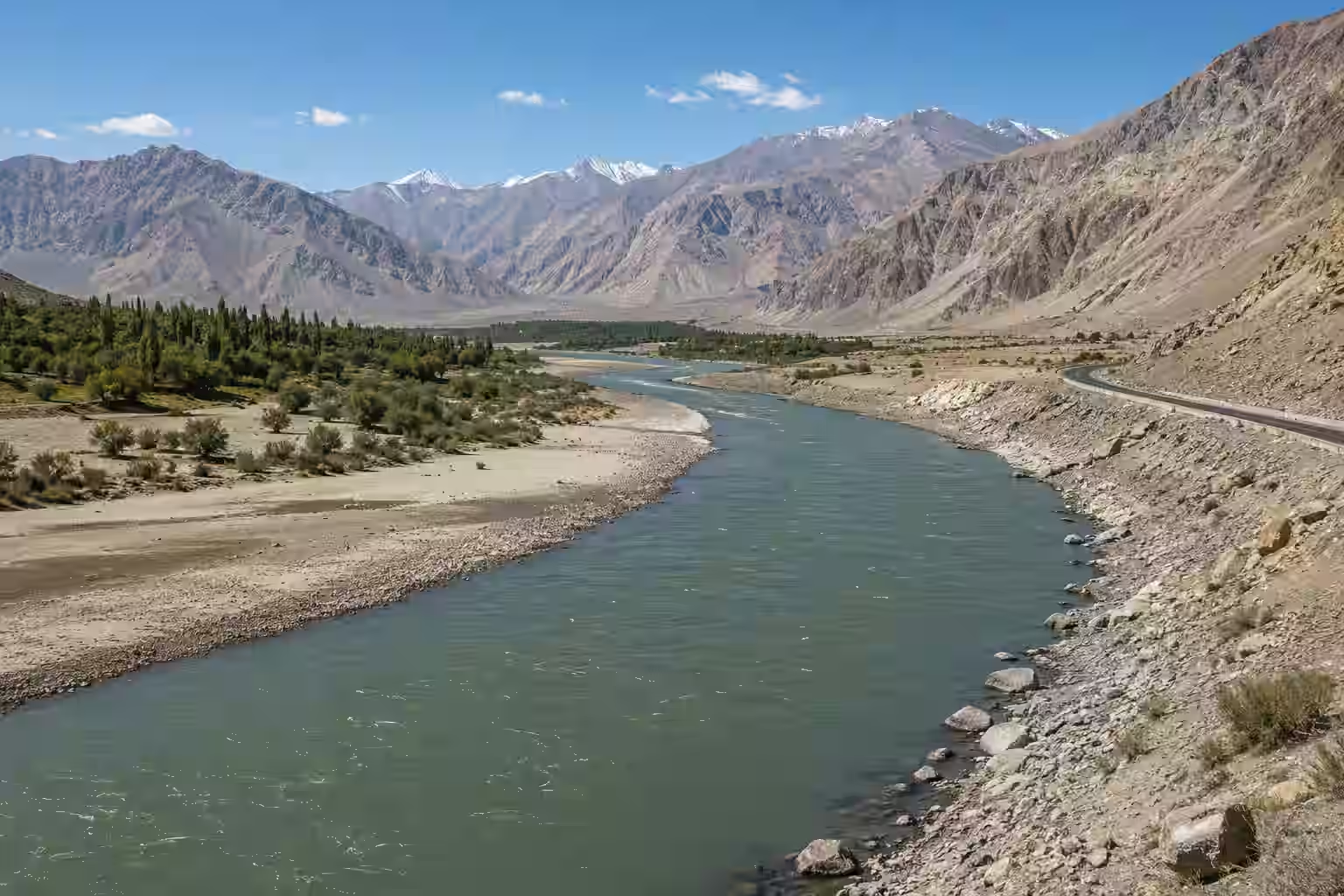
The treaty itself is far older than the current dispute. Signed in 1960, it created a system for sharing the waters of the Indus river basin between India and Pakistan. The eastern rivers Ravi, Beas and Sutlej were allocated primarily for India’s use, while Pakistan received the main use of the western rivers — the Indus, Jhelum and Chenab.
The arrangement did not completely prevent India from using the western rivers. The treaty allows India certain uses, including hydroelectric power generation, but places detailed restrictions on the design and operation of such projects. The current dispute centres largely on how those restrictions should be interpreted.
That is where the Ratle project enters the picture.
Ratle is a run-of-river hydroelectric project being developed on the Chenab in Jammu and Kashmir. Pakistan has challenged aspects of the project’s design, arguing that they do not comply with the treaty. Similar questions have been raised over the Kishenganga hydroelectric project.
The treaty provides more than one mechanism for resolving disagreements. Technical “differences” can be considered by a Neutral Expert, while certain broader “disputes” can be referred to a Court of Arbitration. The World Bank has a limited procedural role in these mechanisms, including making appointments when required under the treaty.
India has argued that the parallel processes pursued by Pakistan create a fundamental problem. New Delhi has favoured the Neutral Expert mechanism for the technical questions concerning the hydroelectric projects and has consistently objected to the Court of Arbitration proceedings.
The Court of Arbitration has taken a different view.
In its August 31 award, the tribunal said India’s April 2025 decision to place the treaty in abeyance could only amount to a claim that the treaty had been suspended or terminated. It examined the grounds put forward by India and unanimously concluded that none justified suspension or termination. The court therefore held that the treaty remains in force.
The ruling does not, however, finally determine whether the Ratle project itself complies with every technical requirement of the treaty.
That question remains before the Neutral Expert appointed through the treaty process.
Until that process is completed, the Court of Arbitration has imposed interim restrictions on Ratle. The order prohibits India from carrying out certain concreting work on the dam wall and power intake structure above specified levels. Those restrictions will remain until 90 days after the Neutral Expert issues a final decision, which is currently expected around July 2027. The court also ordered reporting measures concerning the project’s construction schedule.
For India, the legal dispute is closely connected to a larger strategic question: how much freedom should the country have to develop the water and energy resources of Jammu and Kashmir under an agreement negotiated more than six decades ago?
For Pakistan, the stakes are different. The Indus river system is central to its agriculture and water security, making changes to the treaty particularly sensitive. The agreement has continued through wars, military crises and repeated periods of hostility between the two countries, which is one reason the current confrontation carries such significance.
The latest developments have therefore created an unusual situation. The international tribunal says the treaty remains legally binding. India says the tribunal itself has no jurisdiction and that its decision will not affect New Delhi’s actions. Meanwhile, the separate Neutral Expert process concerning the hydroelectric projects continues.
That means Monday’s ruling is unlikely to close the dispute. Instead, it leaves India and Pakistan with competing legal positions that could shape the next stage of their already difficult relationship.
There is also a practical issue behind the legal arguments. The Indus system is not an abstract line in a treaty document. It is a network of rivers that supports farms, towns, power projects and millions of people on both sides of the border.
For India, the immediate position is clear: the Hague ruling has not changed its decision to keep the treaty in abeyance. For Pakistan, the tribunal’s conclusion provides a legal basis for insisting that the treaty continues to bind India.
The next important point may therefore come not from another political statement, but from the technical proceedings on Ratle and Kishenganga.
Until then, the Indus Waters Treaty remains caught between two very different realities an international tribunal that says the agreement remains in force, and an India that says the body delivering that judgment has no authority over its decisions.
What happens next could determine not only the future of two major hydroelectric projects, but also how one of South Asia’s longest-running water-sharing arrangements survives its most serious political challenge in decades.