



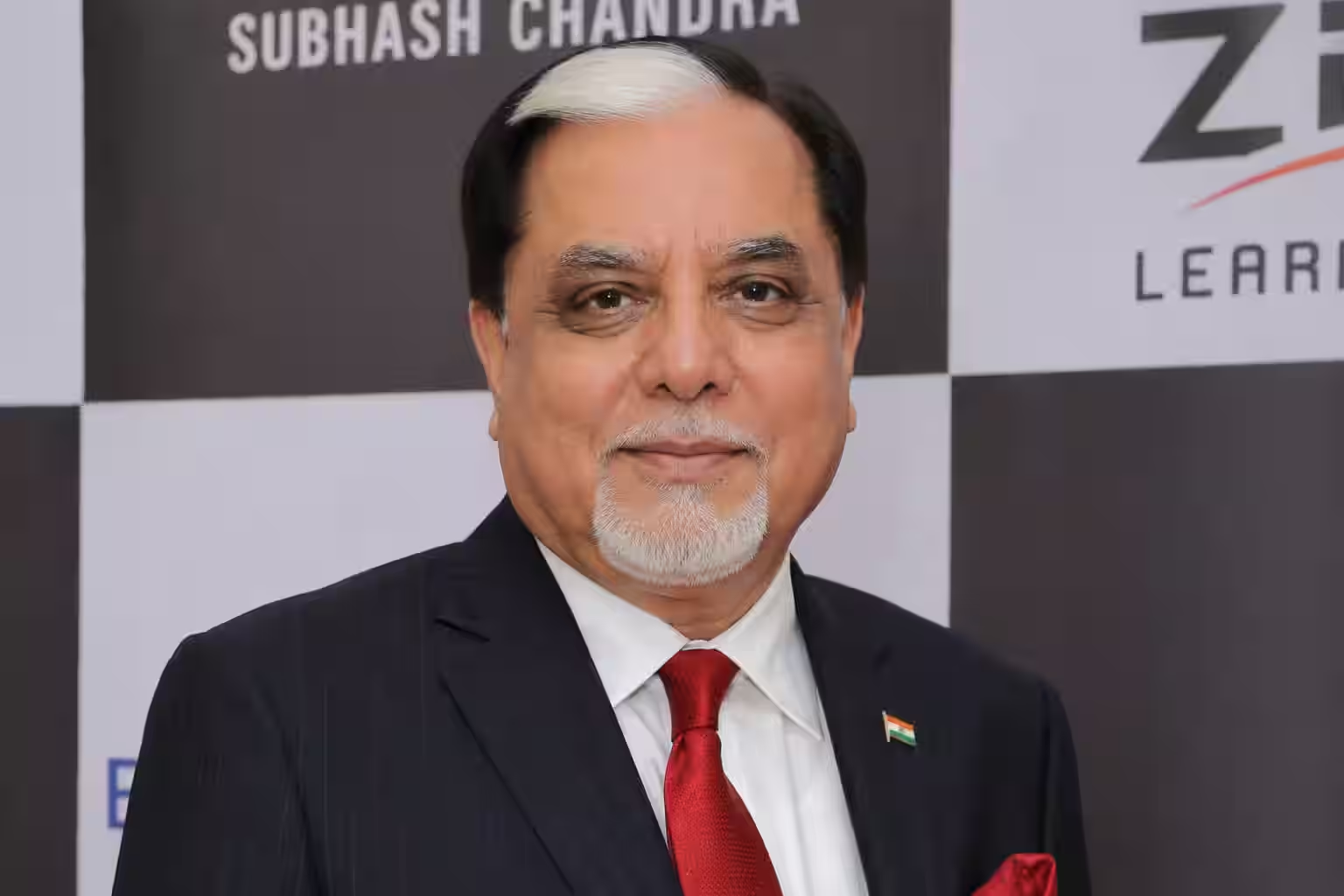
New Delhi: A repayment plan approved for Essel Group founder Subhash Chandra has opened a new legal fight between several lenders and the National Company Law Tribunal (NCLT).
The Delhi bench of the NCLT approved the plan on August 25, under which ₹6.25 crore will be paid to creditors in Chandra’s personal insolvency proceedings. Another ₹25 lakh has been provided towards the costs of the insolvency process.
The striking part is the difference between that payment and the claims admitted in the case.
The NCLT order records admitted claims of ₹22,006.57 crore.
That figure, however, needs some explanation. It does not mean that Chandra personally took a ₹22,000-crore loan from banks.
The insolvency proceedings relate to personal guarantees and indemnities that Chandra had given in connection with borrowings by companies linked to the Essel Group. When those companies faced difficulties in repaying their obligations, lenders pursued claims connected to those guarantees.
Chandra has disputed the way the ₹22,000-crore figure has been presented.
In a statement, his side said the claims of lenders that opposed the repayment plan against him as a personal guarantor were around ₹3,992 crore. His position is that the larger figure should not be described as a personal debt that he directly borrowed.
That distinction is important because the companies that originally borrowed the money continue to have their own liabilities.
The repayment plan was approved after a vote by the creditors involved in the proceedings. The NCLT said creditors representing 80.81% of the voting share supported the plan.
Several lenders, however, voted against it.
LIC Housing Finance, HDFC Bank, Axis Bank, Canara Bank, Union Bank of India (UK) and RBL Bank were among those that opposed the proposal.
LIC Housing Finance had an admitted claim of ₹1,322.39 crore. Under the approved plan, its proposed recovery is around ₹38.09 lakh.
The lender is now preparing to challenge the decision.
On August 29, LIC Housing Finance said it would file an appeal before the National Company Law Appellate Tribunal (NCLAT), along with other public financial institutions. Canara Bank and Union Bank of India (UK) also said they would challenge the NCLT order.
Canara Bank said it had voted against the plan and had also sought a forensic audit during the proceedings. The bank said the request could not be pursued because of its minority voting share.
Union Bank of India (UK) said it had also opposed the plan before the NCLT and would immediately approach the NCLAT.
HDFC Bank is also considering an appeal. The private lender said it had opposed the repayment plan and was examining its legal options.
The lenders’ objections go beyond the amount they are expected to recover.
Some creditors questioned the voting process and whether certain entities supporting the repayment plan had links with Chandra that could affect their eligibility to vote.
The NCLT considered those objections in its August 25 order.
The tribunal did not accept the argument that the five entities identified by dissenting creditors should automatically be treated as associates of Chandra for voting purposes. It said the evidence before it did not establish the legal requirements needed to disqualify those entities from participating in the vote.
The tribunal also examined claims submitted by individuals on behalf of groups of creditors.
Claims submitted through Anil Kumar on behalf of 960 people and Sunil Jain on behalf of 300 people were among those reviewed. The NCLT found that the claims did not have sufficient documentary support and directed that they be excluded from the final list of creditors.
The tribunal’s decision also focused on a practical question: how much could creditors actually recover from Chandra’s personal assets?
The NCLT considered the value of his personal estate and the likely recovery available if the repayment plan was rejected. Its reasoning was that forcing Chandra into bankruptcy would not necessarily produce a better result for creditors.
That is an important part of understanding the case.
In insolvency proceedings, the amount claimed by creditors and the amount that can ultimately be recovered are not necessarily the same. Recovery depends on the assets available, existing liabilities, guarantees and the legal framework governing the case.
So the ₹22,006.57-crore figure should not be read as a ₹22,000-crore cash loan that has simply been reduced to ₹6.25 crore.
It represents the admitted claims in Chandra’s personal insolvency proceedings. The ₹6.25 crore is the amount to be distributed to creditors under the repayment plan approved by the NCLT.
The difference between the two figures has nevertheless become the central reason for the lenders’ challenge.
The plan was approved because the required majority of creditors voted in favour. The lenders opposing it held a smaller share of the voting rights and could not block the proposal.
That does not prevent them from challenging the tribunal’s decision.
The matter will now move to the NCLAT, where the lenders can present their objections to the repayment plan and the NCLT’s reasoning.
For Chandra, the case is also about how his personal guarantees should be treated and how the claims against him should be calculated. His side has rejected the suggestion that he personally borrowed ₹22,000 crore and has disputed the larger claims figure being used in public discussion.
For the lenders, the issue is whether the approved plan provides an acceptable recovery and whether the process leading to its approval was properly followed.
Those questions will now be tested before the appellate tribunal.
The case has significance beyond Chandra’s personal insolvency proceedings.
Personal guarantees are commonly used when promoters and company founders support corporate borrowing. When a company defaults, those guarantees can bring the individual guarantor into a separate legal and financial process.
That makes the outcome relevant not only to the lenders involved in this case but also to other banks, financial institutions and corporate promoters.
For now, the NCLT’s repayment plan remains in place, but the dispute is far from over.
Canara Bank, Union Bank of India (UK) and LIC Housing Finance are preparing their appeals, while HDFC Bank is also considering a challenge.
The next decision will therefore come from the NCLAT.
Until then, the headline numbers ₹22,006.57 crore in admitted claims and ₹6.25 crore proposed for repayment — tell only part of the story.
The more important question is how India’s insolvency system will ultimately deal with the guarantees, the competing claims and the lenders’ challenge to the repayment plan.