



For families who have already watched floodwater destroy homes, roads and bridges, the disaster in Nepal is far from over.
The flash floods that swept through the Bhote Koshi and Trishuli river systems on August 26 have left hundreds dead and thousands of people unaccounted for. Rescue teams are still searching through damaged settlements and difficult mountain terrain, while families continue to wait for information about relatives who have not returned.
The disaster has also created another concern upstream.
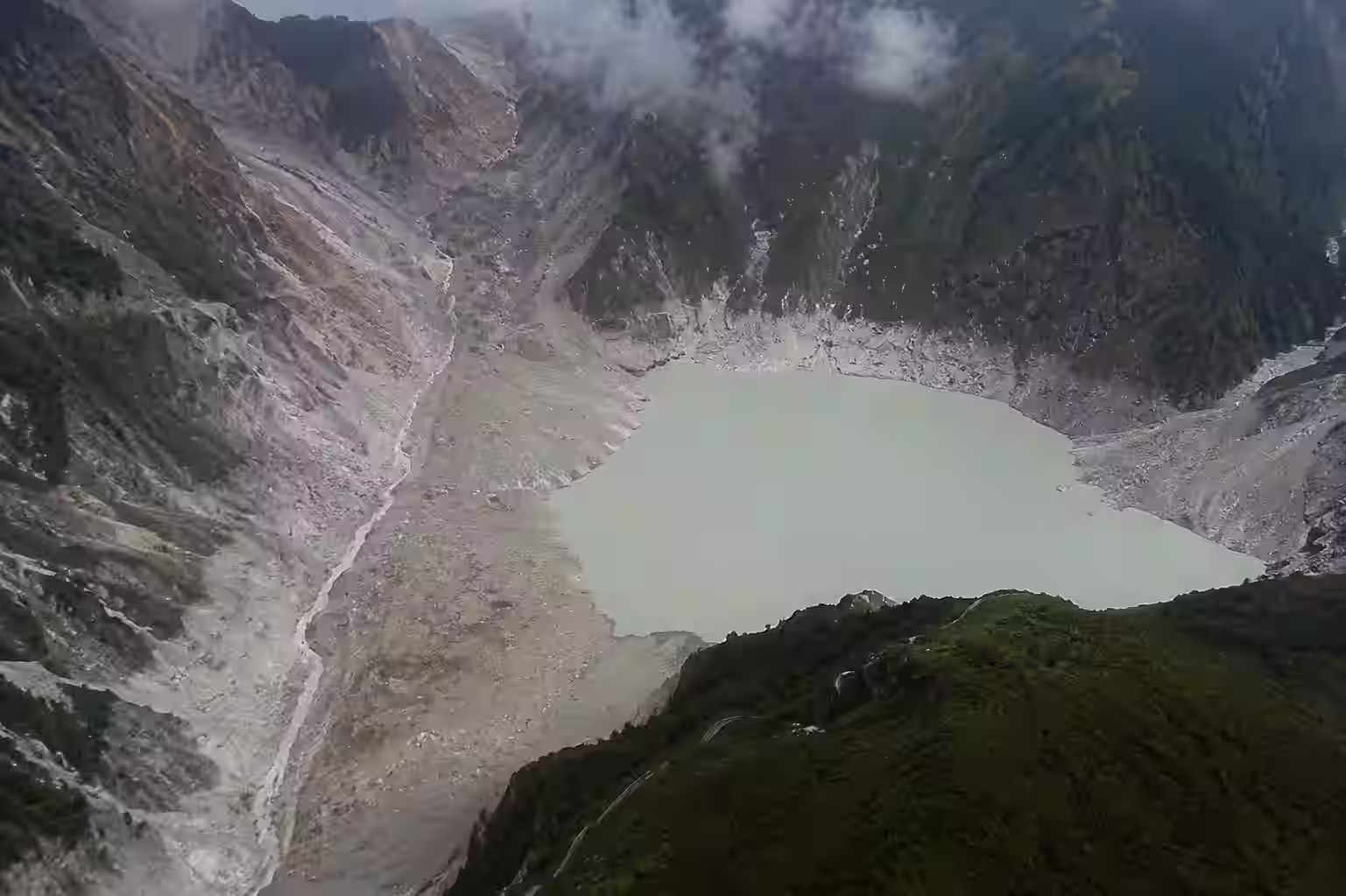
A barrier lake formed near the Nepal-China border after a large amount of ice, rock, soil and other debris blocked a river channel. Water collected behind the natural blockage, raising fears that a sudden release could send another surge downstream.
For people living along the Bhote Koshi and Trishuli river corridors, the possibility of another flood has added to an already difficult situation.
Nepal’s Department of Hydrology and Meteorology (DHM), through its Flood Forecasting Division, said on August 29 that flood risk remained in the Bhote Koshi region of Rasuwa. Although water levels in the Bhote Koshi and Trishuli rivers were below the warning level at the time, the division advised people to stay away from riverbanks and remain alert to early warnings because of the barrier lake upstream.
The warning came as rescue operations were still underway.
According to Nepal’s Ministry of Foreign Affairs, 626 bodies had been recovered by Saturday afternoon and about 2,400 people were still unaccounted for. More than 4,450 people had been rescued, including more than 187 foreign nationals. The ministry cautioned that the figures could change as search and identification work continued.
The National Disaster Risk Reduction and Management Authority (NDRRMA) later reported that the death toll had reached 675, with 2,426 people still unaccounted for. The difference between the figures reflects the rapidly changing situation as bodies are recovered and information from affected areas is verified.
For families, however, the numbers do not tell the whole story.
Many are still trying to find relatives who disappeared when the flood swept through villages, work sites and roads. In Kathmandu and other locations, relatives have been checking hospitals, rescue lists and information centres for news.
The Nepali Army, Nepal Police and Armed Police Force have been involved in the search, along with local authorities and emergency workers.
The Nepali Army said 191 workers were rescued from hydropower tunnels after becoming trapped during the floods. Its teams had also rescued more than 2,100 people through land and air operations by August 29.
The rescue operation has not been straightforward.
The flood damaged bridges and roads and left parts of the affected region difficult to reach. Helicopters have been used to evacuate people from isolated areas, while ground teams have been searching through mud, rocks and debris.
Then came the concern over the barrier lake.
The lake formed near the confluence of the Chhochen Khola and Purepu Tsangpo rivers, which originate in Tibet before flowing into Nepal as part of the Bhote Koshi river system.
Chinese authorities had earlier informed Nepal that around 2 million cubic metres of water had accumulated in the lake, with another 3 million cubic metres potentially entering it over three days. That raised concern about the possibility of a sudden breach.
The concern became particularly serious on August 28, when the lake was reported to be overflowing. Rescue operations in Rasuwa were temporarily interrupted while authorities assessed the situation, and people in vulnerable areas were urged to move to safer locations.
But the latest information has been more mixed.
Nepal’s Flood Forecasting Division said on August 29 that preliminary analysis of satellite images and information received from China indicated that the barrier lake was expanding and still presented a breach hazard. The division warned that a breach could send water, rocks, soil and debris downstream in a sudden flash flood.
At the same time, Chinese authorities reported that the lake had begun to drain.
China’s Ministry of Water Resources, according to Chinese state broadcaster CCTV and reporting by Reuters, said satellite images showed the lake’s surface area had fallen and parts of the lake bed had become visible. The development suggested that the immediate risk of a major outburst had eased.
The differing updates underline why officials are continuing to monitor the area rather than declaring the danger over.
Nepal is monitoring more than one upstream water body, and officials have said flood risks could remain until the lakes are fully drained.
For rescue teams, that means the search for missing people must continue alongside monitoring of the river system.
The government has also asked the public and media to rely on verified information. Nepal’s Ministry of Foreign Affairs specifically appealed against publishing unconfirmed reports as casualty and missing-person figures continue to change.
The disaster has affected more than homes and roads.
Hydropower projects in the region were badly hit, with workers among those trapped by the flood. Bridges and sections of road infrastructure have also been damaged, making it harder for rescue teams and supplies to reach some communities.
The longer-term cost is expected to be substantial. Nepal’s Finance Minister Swarnim Wagle told Reuters that the government’s initial estimate for rebuilding damaged infrastructure was between $4 billion and $5 billion, although the assessment is still continuing.
International assistance is also arriving.
India has sent relief supplies and technical teams, while China has provided technical assistance related to the affected border region. Nepal has said it needs specialist help with tunnel rescue, DNA identification, body storage, transport links and damaged infrastructure.
For now, the most urgent task remains the search for people who are still missing.
The barrier lake is being monitored closely, but the immediate situation is no longer being described simply as a lake that is certain to burst. Water levels and satellite images are being watched as conditions change.
For families along the Bhote Koshi and Trishuli rivers, however, uncertainty remains.
They have already experienced the force of a flood that arrived with little time to react. Now they are waiting for news about loved ones while watching the river and listening for the next official warning.
The rescue operation will continue as long as people remain missing.
And even after the water recedes, the work will not be finished. Homes will have to be rebuilt, roads and bridges restored, damaged hydropower facilities assessed and families helped to recover their livelihoods.
For the people living through the disaster, the flood is not simply a headline.
It is the search for a missing family member, a damaged home, a closed road or a livelihood that may take years to rebuild.