





Saturn Has a Strange New Shape: Hubble Finds a 10-Sided Wave at Its South Pole
Saturn has surprised astronomers again. A new set of images from the Hubble Space Telescope shows a huge 10-sided wave moving around the planet’s south pole.
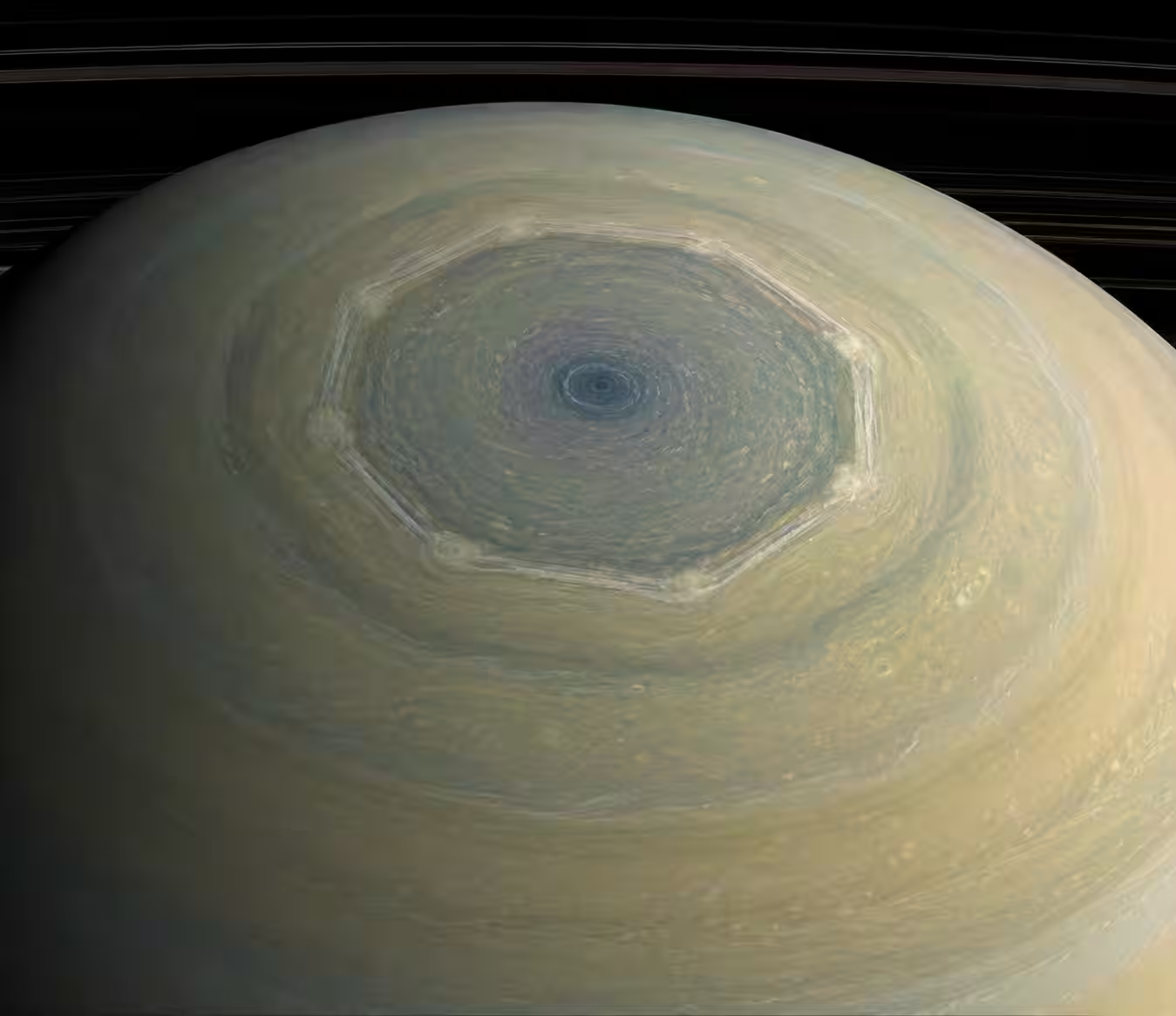
The discovery is drawing attention because Saturn is already famous for another unusual shape. At its north pole, the planet has a giant six-sided pattern that has remained visible for more than 40 years. Now scientists have found a very different polygon on the opposite side.
The new feature is called a decagon. It sits inside one of Saturn’s powerful jet streams and appears to be changing over time. Researchers say this is the first large, regular-sided jet pattern seen in Saturn’s southern hemisphere.
The findings were published on September 2 in the journal Science Advances. The study was led by Agustín Sánchez-Lavega of the University of the Basque Country in Spain. NASA astronomer Amy Simon and Michael Wong of the University of California, Berkeley, are among the co-authors.
The first signs of the strange pattern appeared in images taken in 2023. Saturn’s changing seasons had gradually brought its south pole back into view from Earth. By 2024, Sánchez-Lavega and amateur astronomers Trevor Barry and Jean-Paul Oger noticed an unusual, wavy band near the pole while studying images taken from the ground.
More observations followed in 2025. The pattern became easier to see, and Hubble observations confirmed that it was not simply a short-lived cloud feature.
Scientists had actually been looking for something like this for years.
Saturn’s northern hexagon has been one of the planet’s biggest mysteries since NASA’s Voyager spacecraft photographed it during flybys in 1980 and 1981. Because Saturn’s atmosphere appears broadly similar in the north and south, researchers had wondered whether a matching structure might exist at the south pole.
They had not found one.
Images from NASA’s Cassini spacecraft, which studied Saturn between 2004 and 2017, showed no sign of a long-lasting polygon at the southern pole. That makes the new discovery even more interesting. The researchers believe the decagon may have formed sometime between 2017 and 2023, although they cannot yet say exactly when it appeared.
The new pattern is also enormous. One side of the decagon already stretches more than 16,700 kilometres. That is wider than Earth.
It is not sitting still, either. Unlike the northern hexagon, which is almost stationary, the southern decagon is moving eastward at about 10 kilometres per hour. It is also part of a powerful jet stream where winds can reach hundreds of kilometres per hour.
Hubble observations show that the feature extends through several layers of Saturn’s atmosphere. Scientists reached that conclusion by looking at the planet using different wavelengths of light. Each wavelength can reveal activity at a different height.
That gives researchers more than just a picture of an unusual shape. It gives them a chance to study how Saturn’s atmosphere works below the visible cloud tops.
But there is still a big question: how did the decagon form?
Sánchez-Lavega and his colleagues believe the answer may lie in the jet stream around Saturn’s south pole. An instability in the powerful winds could have created the wave. Another possibility is that waves deeper in the atmosphere are helping to drive the pattern.
Scientists are also interested in possible similarities with Jupiter. Large groups of storms around Jupiter’s poles can form polygon-like arrangements, although the patterns are not the same as Saturn’s hexagon or decagon.
For Amy Simon, one of the most interesting parts of the discovery is that the feature appears to have formed recently.
“We’ve never seen anything quite like this in Saturn’s southern hemisphere,” Simon said. She noted that the northern hexagon has been visible whenever scientists have looked for it for more than four decades. The southern feature is different because it appears to be getting stronger.
That change could give scientists something they rarely get to see on a planet this far away: the development of a giant atmospheric structure over time.
Hubble’s long-running Outer Planet Atmospheres Legacy programme has made that possible. The programme has been photographing the outer planets regularly for more than a decade. Instead of relying on one photograph, scientists can compare observations taken years apart and follow changes in storms, clouds and atmospheric patterns.
Michael Wong, another member of the research team, said many discoveries from the programme come from years of observations rather than a single image.
That is important for the decagon. Scientists still do not know whether it will remain for decades like the northern hexagon or slowly disappear as Saturn’s atmosphere changes.
For now, the team plans to keep watching it. More observations from Hubble and the James Webb Space Telescope, along with computer modelling, could help explain why the pattern appeared and what keeps its 10-sided shape together.
Saturn already had one famous geometric mystery at its north pole. It now has another at the south.
And unlike the old hexagon, which scientists have watched for decades, this new shape may give them a rare opportunity to see a planetary mystery developing in front of them.