



China has taken another step into a part of the space business that once looked almost impossible: bringing a rocket back to Earth and preparing it to fly again.
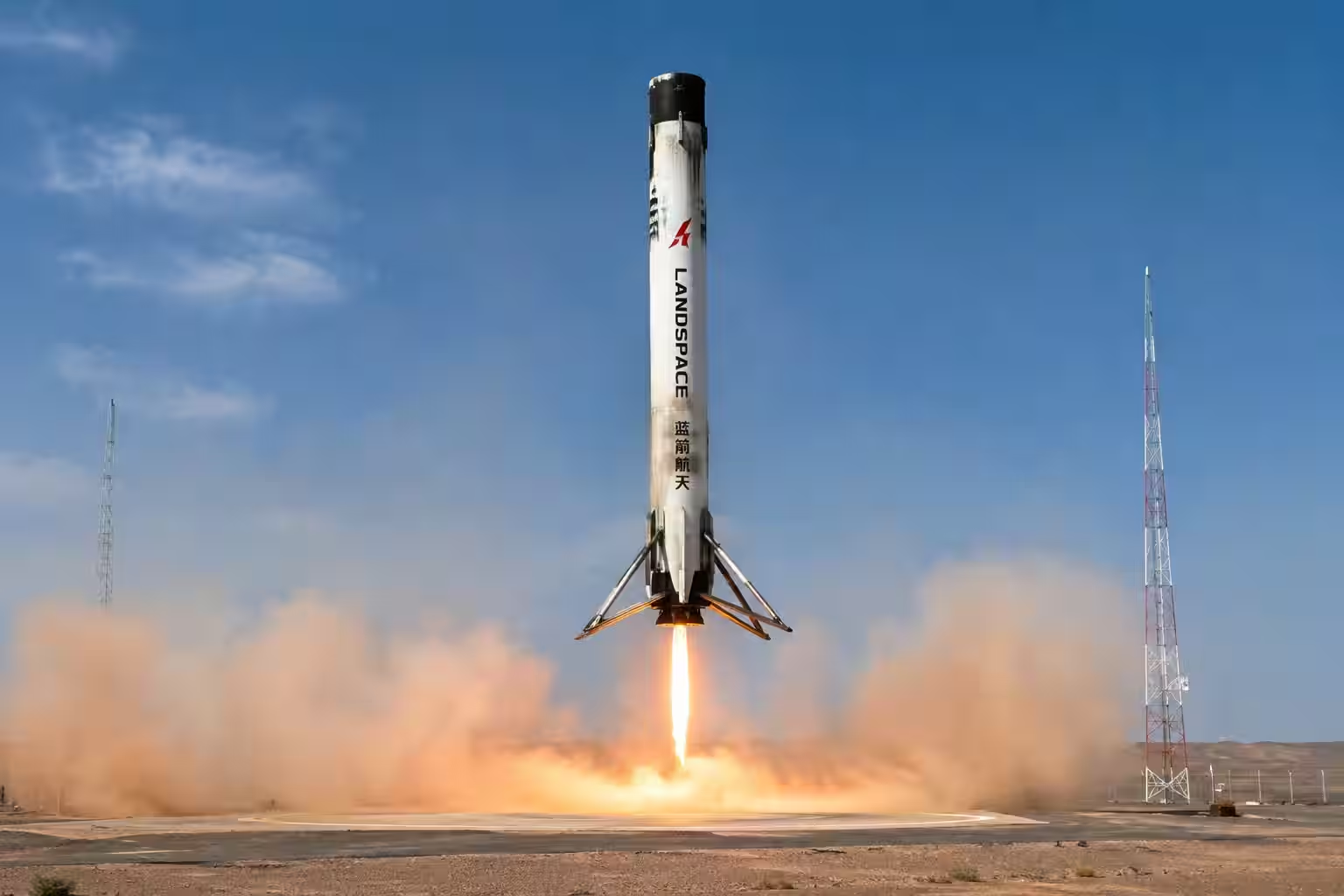
Private Chinese company LandSpace successfully landed the first stage of its Zhuque-3 rocket on August 19, completing the country’s first successful land-based recovery of an orbital-class booster by a private company.
The 66.1-metre rocket lifted off from northwestern China, sent the Honghu-03 satellite towards orbit and then brought its first stage down at a landing site in Gansu province, about 390 kilometres from the launch site.
It was not LandSpace’s first attempt. The company tried to recover a Zhuque-3 booster during its first flight in December 2025, but the landing did not succeed. This time, the booster completed the descent and touched down upright on four landing legs.
That distinction matters because getting a rocket into space is only half the problem. The expensive part is what happens afterwards.
For decades, most rockets were treated as disposable vehicles. They carried their payload into space and then fell back to Earth, never to fly again. Reusability changes that equation. If a booster can be recovered, checked, repaired and launched again, the same piece of hardware can potentially support several missions instead of being discarded after one.
This is where SpaceX changed the industry.
The US company did not invent the idea of reusable spacecraft or rockets. But its Falcon 9 became the first orbital-class rocket to successfully land vertically in December 2015. In March 2017, SpaceX flew an orbital-class booster for a second time, turning what had been a major engineering challenge into something that could become part of a regular launch business.
That is the benchmark companies such as LandSpace are now trying to reach.
Zhuque-3 uses nine methane-and-liquid-oxygen engines and is designed to carry up to 14.2 tonnes to low Earth orbit in its expendable configuration, compared with 22.8 tonnes for a Falcon 9, according to LandSpace. The Chinese company says its first-stage booster is designed for up to 20 flights and hopes to put a recovered booster back into service within six months.
China’s progress is not limited to one company. In July, the country successfully recovered a Long March-10B first stage using a net system on a floating platform. That gave China experience with a different recovery method before LandSpace’s successful land landing.
But there is an important test still ahead for LandSpace.
Landing the booster is a major achievement. Reusing it is the harder one.
The company now has to inspect the recovered stage, determine how much refurbishment it needs and eventually fly it again. Chinese state media has described the post-landing inspection and maintenance system as a major challenge for the programme.
That is also why this story is bigger than a single successful landing in the Gobi Desert.
The commercial space industry is increasingly focused on launching satellites more often and at lower cost. Reusable boosters could help make that possible, provided companies can demonstrate that recovery does not simply work once, but works repeatedly and safely.
SpaceX has spent years building that experience. LandSpace has just taken its first major step.
China has now shown that a private company can launch an orbital-class rocket, send a payload into orbit and bring the booster back to Earth.
The next question is the one that will really matter: how soon can that same rocket fly again?