



Swara Bhasker’s comments on the Jauhar sequence in Sanjay Leela Bhansali’s Padmaavat have reopened a debate that has never really disappeared about honour, survival and how the actions of Rajput women during medieval sieges should be understood today.
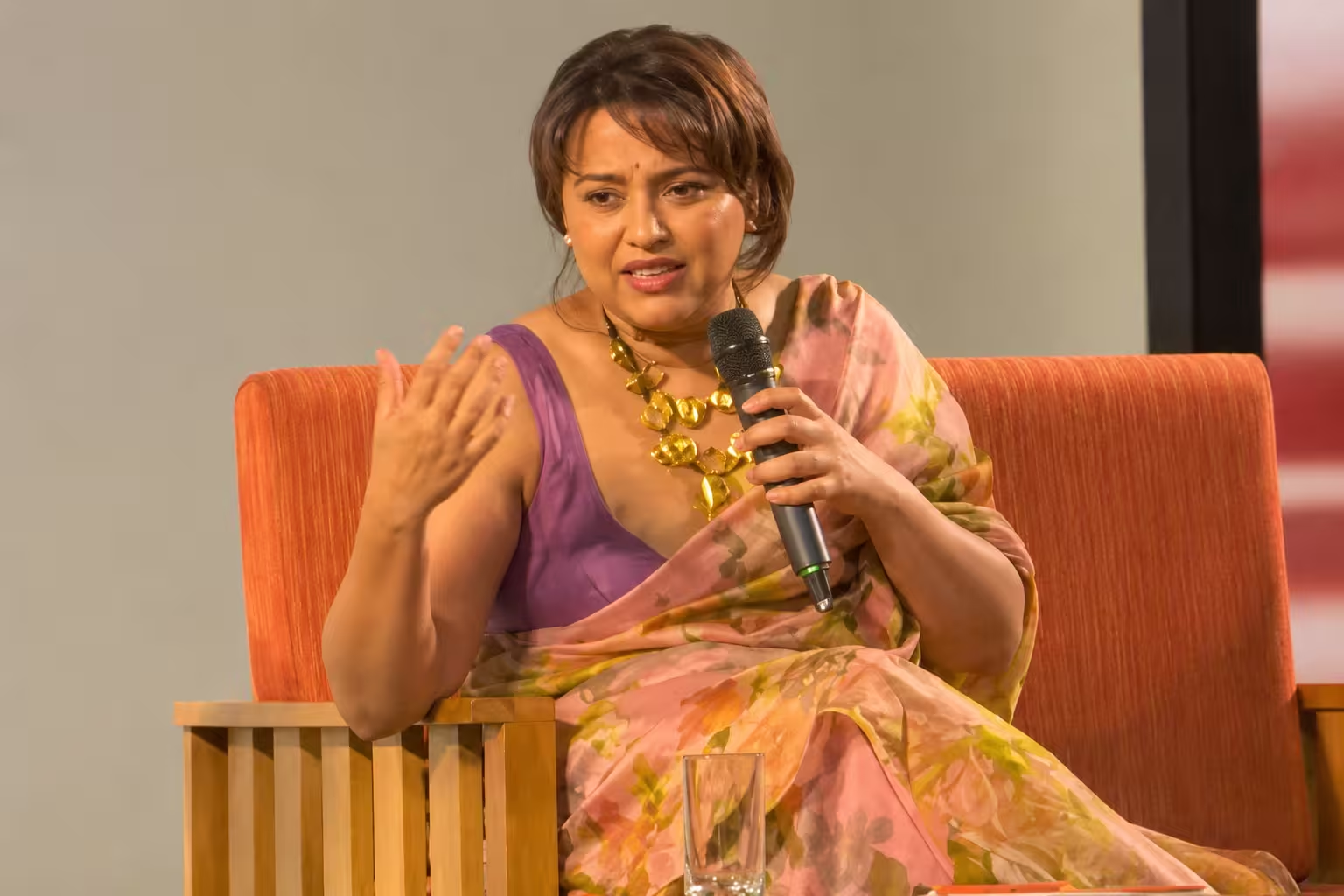
Speaking at the Woman, Life, Freedom event at the India International Centre in New Delhi on August 31, Bhasker recalled why she had written an open letter to Bhansali after watching Padmaavat in 2018.
While describing her reaction to the film’s climax, she said that if she were a rape survivor, she would feel like a “coward” for not having killed herself to save her honour.
Her exact argument was about the message she believed the scene could send to a woman who had survived sexual violence. She questioned whether a film should leave survivors feeling that they had somehow failed to protect their honour by remaining alive. She also asked whether rape should ever be presented as the end of a woman’s life.
That use of the word “coward” quickly became the centre of the controversy.
Critics interpreted the remark as an attack on the women who chose Jauhar in the historical tradition associated with Rajput communities. The criticism became particularly sharp because Jauhar has long been remembered within Rajput history as an act connected with honour and resistance when defeat appeared unavoidable.
But there is an important distinction in what Bhasker actually said. She did not call Rani Padmaavati a coward. She did not call the women shown entering the flames in Padmaavat cowards either.
After the clip spread online, Bhasker posted a video saying that her words had been “completely mistranslated” and that she was speaking about how a rape survivor might interpret the scene, not passing judgment on the women who performed Jauhar.
The historical question, however, is much older than the current social-media argument.
Jauhar was associated with situations in which a besieged fort or kingdom was facing defeat and there appeared to be little possibility of escape or outside help.
Historical descriptions portray it as a collective act in which women and other dependants entered the fire rather than face what they believed could follow the fall of the fort. The practice has been linked to fears of captivity, enslavement, sexual violence and loss of honour.
For the communities that remembered these episodes as part of their history, Jauhar was therefore not understood simply as an act of weakness or surrender. It was presented as a final decision in circumstances where capture was seen as a fate worse than death.
That does not mean every historical account can tell us exactly what every woman wanted or how much individual choice was possible. Jauhar happened within a deeply hierarchical medieval society, during wars and sieges where women had very limited control over the circumstances around them. Historians therefore have to be careful about describing every episode as either completely voluntary or completely forced.
But calling the women cowards is also not an accurate description of how the tradition has been understood historically.
There is another important correction to the debate. Jauhar cannot simply be described as Rajput women refusing to be seen or touched by “the Mughals”. Some of the best-known episodes associated with Chittor took place before the Mughal Empire was established. The first major siege of Chittor traditionally associated with Jauhar occurred in 1303 during Alauddin Khalji’s campaign, more than two centuries before Babur founded the Mughal Empire.
The word “honour” also had a very different meaning in that world. It was closely tied to family, community, status and the fate of a defeated kingdom. Women’s bodies could become symbols of the honour of an entire household or community. That is one reason the history of Jauhar remains so emotionally powerful and difficult to separate from the social values of the period.
Bhasker’s criticism comes from a completely different modern perspective.
Her concern is that when a film presents women choosing death rather than the possibility of sexual violence, modern audiences particularly survivors of rape could interpret the scene as suggesting that death is preferable to surviving an assault. That is the point she has continued to defend after the backlash.
The counterargument is that a medieval siege and a modern survivor of sexual violence are not the same situation. Jauhar was associated with the anticipated fall of a kingdom and the possibility of capture, while rape is a crime committed against a person. The circumstances, choices and social realities are fundamentally different.
That difference is at the heart of the current debate.
Padmaavat itself also adds another layer to the discussion. The 2018 film is based on Malik Muhammad Jayasi’s 16th-century epic poem Padmavat and presents a dramatic version of the story of Rani Padmaavati, Rawal Ratan Singh and Alauddin Khilji. The historical status of Padmaavati herself is a complicated subject, with the popular story and the historical record not always treated as the same thing.
So the argument now taking place is not simply about one word spoken by an actor.
It is about whether Jauhar should be remembered primarily as an act of courage and honour, examined as a tragic consequence of medieval warfare and patriarchy, or discussed through the lens of modern ideas about women’s rights and survival.
Bhasker has made clear what she believes the film’s message can mean for rape survivors. Those defending the historical tradition are equally clear that the women who chose Jauhar should not be reduced to the word “coward”.
Perhaps the more useful way to look at the controversy is to recognise both realities. A woman who survives sexual violence today has every right to live without shame, and a historical community that remembers women who chose death during the fall of a kingdom may understand those women through a very different idea of honour and courage.
More than a century of history cannot be reduced to one word from a viral video. And the women at the centre of the old stories deserve more than that.