



Jajpur, Odisha: The road to Ratnagiri takes you away from the busy towns and into the quiet hills of Jajpur. There, among green surroundings, old brick walls and carved stone figures remain from a Buddhist centre that once held an important place in the religious and intellectual life of ancient Odisha.
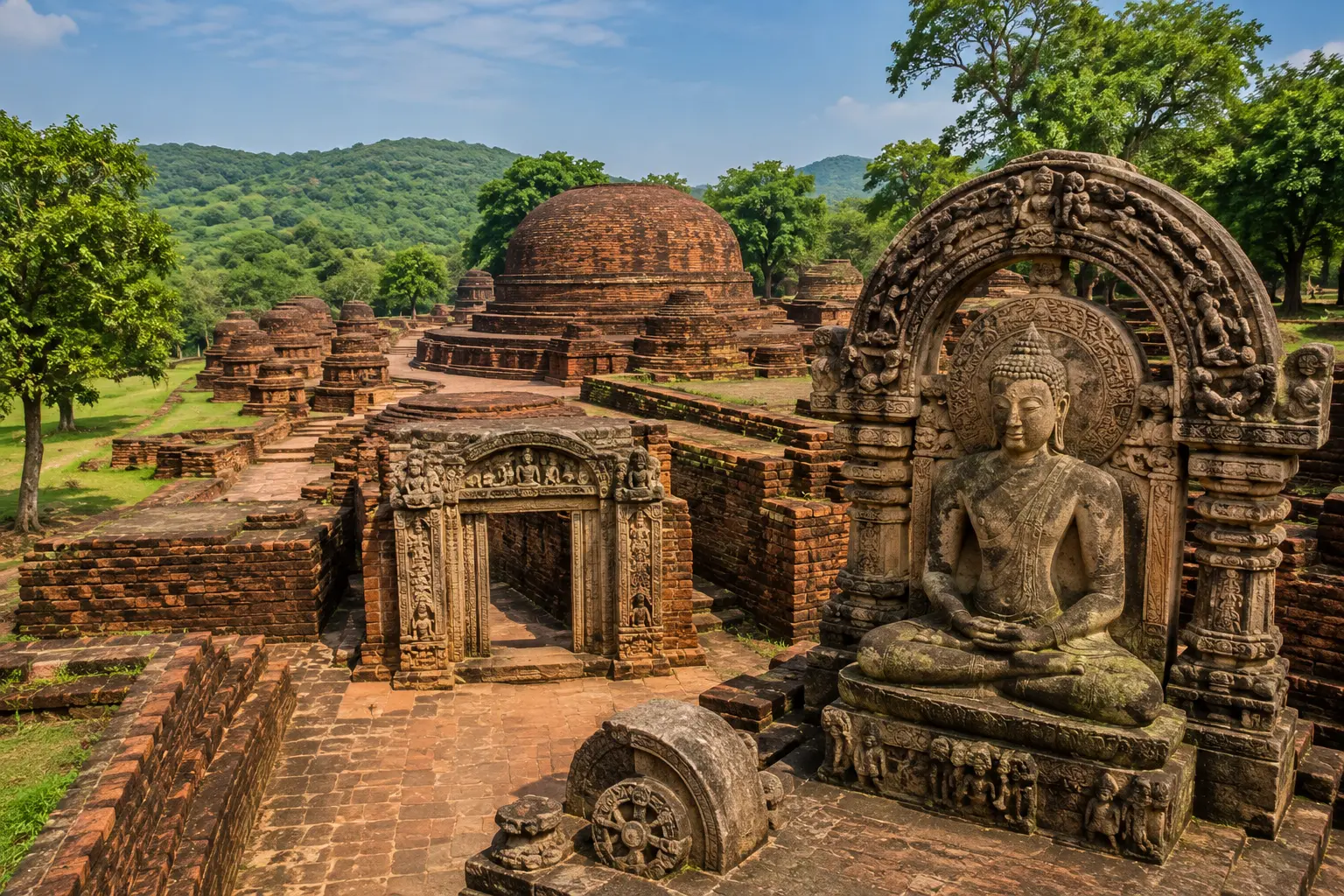
Walk through the remains and the first thing that catches your attention is the amount of history still visible. The entrance to the monastery carries detailed stone carving. Inside, the remains of rooms and courtyards show the scale of the monastic complex, while stupas and sculptures stand across the site. These are not isolated pieces of stone. Together, they tell the story of a place where Buddhist monks lived, studied and practised their faith for centuries.
Archaeological evidence places the beginnings of Ratnagiri around the 4th or 5th century CE, with the site developing significantly over the centuries that followed. Excavations have identified Ratnagiri as the ancient Ratnagiri Mahavihara through sealings bearing its name. Odisha Tourism records its growth from about the fifth century until the 12th century, while UNESCO’s tentative nomination describes Ratnagiri as flourishing broadly between the 4th and 12th centuries.
At the centre of the complex is the Mahastupa, surrounded by numerous smaller votive stupas. There are also monasteries, prayer spaces and a large collection of Buddhist sculptures. Images of Buddha and Bodhisattvas, along with figures associated with Mahayana and Vajrayana traditions, show how Buddhist thought at Ratnagiri changed over time.
That evolution is one of the most interesting parts of Ratnagiri’s story. Buddhism in Odisha did not remain fixed to a single tradition. The wider Buddhist landscape of the region developed from earlier traditions into Mahayana and later Vajrayana practices. Ratnagiri became particularly important during the period of the Bhaumakara dynasty, when Buddhist institutions received royal patronage.
The evidence found here also shows that Ratnagiri was not only a religious site. It was a place of learning and artistic activity. Odisha Tourism describes it as an important centre of Buddhist learning, and its excavations have revealed architecture and sculpture of considerable sophistication. The monastery’s entrance, made from finely carved stone, remains one of the site’s most striking features.
Even the inscriptions help bring the place closer to the people who once lived here. An inscription documented by the Archaeological Survey of India records the renovation of a stupa containing sacred relics, along with the construction of a monastery, a stepped well and a pavilion. It offers a small but valuable glimpse of how people contributed to maintaining the religious community at Ratnagiri.
For centuries, this Buddhist centre remained part of Odisha’s changing religious and cultural landscape. Eventually, its importance declined and the settlement was left behind. Much later, archaeological excavation began to reveal what had been hidden beneath the earth. The major excavations of Ratnagiri in the 1950s opened a new chapter in the understanding of Buddhism in Odisha, followed by further work at the site.
Today, Ratnagiri is part of Odisha’s Buddhist heritage along with Lalitgiri and Udayagiri. Together, the three sites form what is often called the Buddhist Diamond Triangle and are on UNESCO’s Tentative List as a serial cultural heritage nomination. UNESCO describes the group as evidence of the development of Buddhist philosophy and practice across more than a millennium.
Standing among Ratnagiri’s monasteries and stupas, it is easy to think of the site simply as an archaeological ruin. But the stones tell a wider story. They speak of monks and teachers, royal patronage, changing Buddhist ideas, skilled craftsmen and a period when this part of Odisha was connected to a much larger world of religious and intellectual exchange.
Ratnagiri may be quiet today. Its history is anything but quiet.