


In the hills of Niyamgiri, a piece of cloth can tell a story without saying a word.
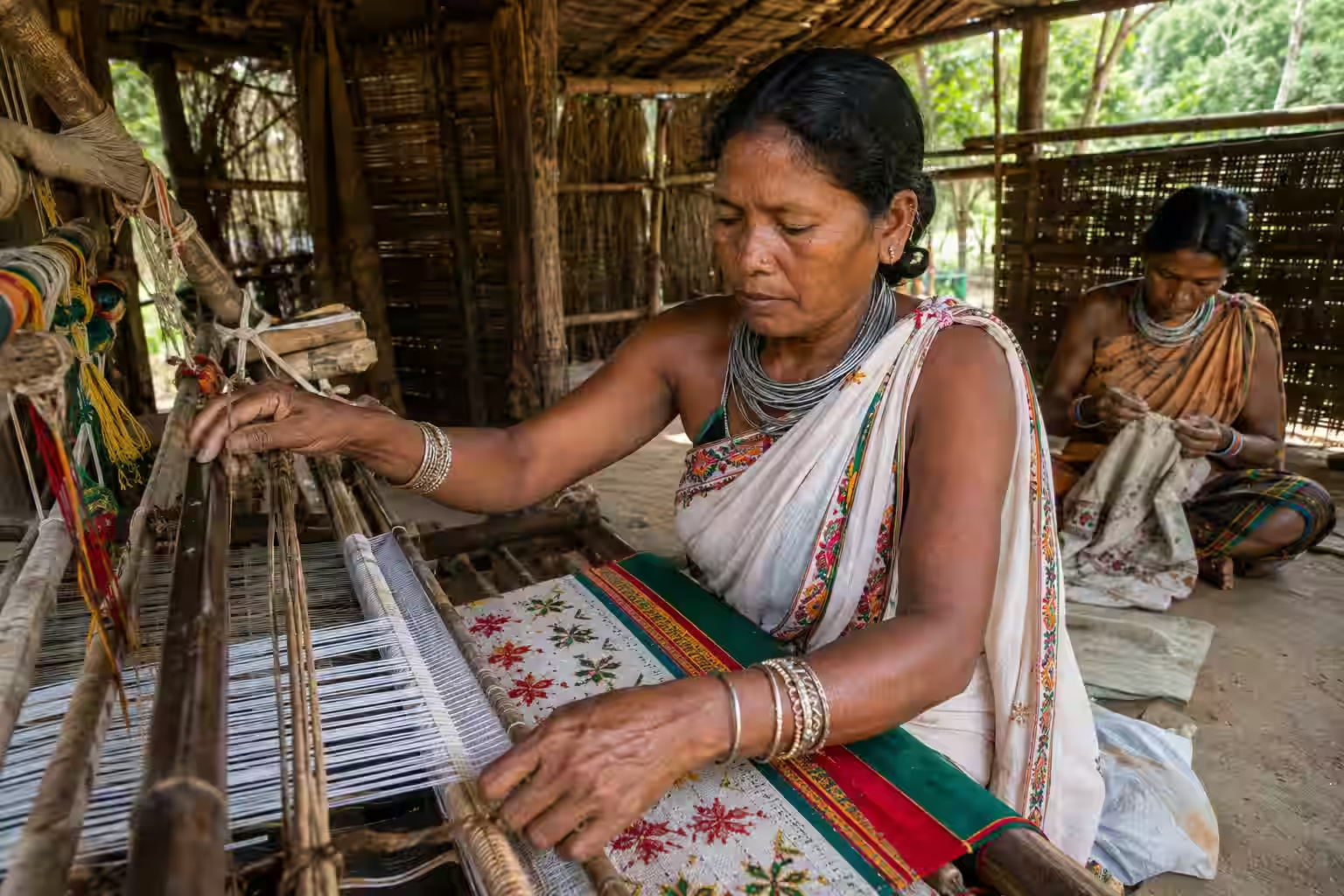
The colours, the patterns and the embroidery on a Kapdaganda shawl are closely tied to the life and traditions of the Dongria Kondh community of Odisha. For generations, Dongria women have carried this skill forward, learning the work within their families and communities.
Today, Kapdaganda is getting attention far beyond Niyamgiri.
But there is a question that deserves just as much attention as the shawl itself:
Are the women who make it benefiting from that growing recognition?
Kapdaganda, also known as the Dongria Kondh embroidery shawl, received a Geographical Indication (GI) registration in January 2024. The official GI record lists it as “Kapadaganda: Dungaria Kondh Embroidery Shawl” and identifies Odisha as its geographical area. The application was filed by the Niyamgiri Dongoria Kandho Weavers Association along with the Odisha government’s Scheduled Castes and Scheduled Tribes Research and Training Institute.
For the community, the GI tag is an important recognition, But a certificate alone cannot make a craft sustainable.
The real story begins with the women sitting down with a piece of cloth, a needle and coloured thread.
Kapdaganda is traditionally made by Dongria Kondh women in the Niyamgiri hills. The embroidery uses colours including green, yellow and red, with motifs carrying meanings connected to the community’s values and way of life. Odisha’s Crafts Museum describes the shawl as an important part of Dongria Kondh cultural identity, worn on occasions such as marriages and festivals.
What looks simple from a distance is anything but simple up close.
Every pattern has to be worked by hand. There is no shortcut for the patience required to complete it.
And the women doing that work have lives beyond embroidery.
They farm. They look after their homes. They take care of their families. Embroidery has to fit around all of that.
That makes the growing demand for Kapdaganda both an opportunity and a challenge.
Recent reporting from Rayagada found that the craft is gaining recognition, but many women artisans still struggle to receive what they believe is a fair return for their work. Traders and middlemen can sell the finished pieces at considerably higher prices, while the artisans themselves may receive much less for the time they put into making them.
That gap is at the heart of the problem.
A traditional craft can become famous without necessarily making the lives of its makers easier.
And Kapdaganda is not a quick product to produce.
Local reporting says some pieces can take two to three months to complete, depending on the amount of embroidery involved. At the same time, reported retail prices can run into several thousand rupees, with some high-end pieces selling for substantially more.
So when a buyer sees a beautiful Kapdaganda shawl in a shop or online, the price tells only part of the story.
Behind it is someone’s time and someone’s skill.
And, in many cases, a tradition that has been passed down through generations.
There is another problem that is less visible to a buyer: the cloth itself.
The traditional coarse cotton fabric used for Kapdaganda has become harder to source locally. According to recent reporting, weavers in Jhigidi village in Rayagada who once produced the base cloth are no longer making it. The state government is now looking at ways to establish a more reliable local supply of the material.
That may sound like a small issue.
It isn’t.
If the material becomes expensive or difficult to obtain, the cost of making the craft rises. And when production becomes harder, fewer young people may see the craft as a practical livelihood.
That is where preservation becomes more than a cultural question.
It becomes an economic one.
The Odisha government has now begun working on a plan that includes local cloth supply, artisan training and measures aimed at strengthening the Kapdaganda production chain. The plan is intended not only to preserve the tradition but also to improve the economic opportunities available to the artisans.
The state already has broader programmes for supporting artisans through training, craft clusters, marketing assistance and skill development. Its handicrafts department says Odisha has about 1.77 lakh artisans practising 64 approved crafts across the state.
But Kapdaganda presents a particularly sensitive challenge.
There is a difference between selling a product and protecting a tradition.
If demand grows too quickly, there can be pressure to produce faster, make cheaper versions and change designs to suit the market.
That may help sales.
But it can also slowly separate the product from the people and culture that gave it meaning in the first place.
The GI tag is supposed to help prevent that kind of disconnect by recognising the link between the product and its place of origin.
Yet the real test of that recognition will not be the certificate hanging on a wall.
It will be what happens in the villages of Niyamgiri.
Can the women who make Kapdaganda earn enough to make the work worth continuing?
Can young people learn the skill without feeling that they have to leave their communities to find a better livelihood?
Can buyers know that the money they pay is reaching the artisans who actually made the piece?
And can the craft become more widely known without losing the identity that makes it special?
Those questions matter because Kapdaganda is not simply another handmade product.
It is part of the cultural life of the Dongria Kondh community.
The Odisha Crafts Museum describes the embroidery as a living expression of that heritage, with its colours and motifs carrying meaning within the community.
That is why the conversation around Kapdaganda should not stop at the GI tag.
Recognition is a good beginning, But recognition has to reach the people.
When a Kapdaganda shawl travels from a small village in Niyamgiri to a shop, an exhibition or a buyer somewhere far away, the story should not end with the person who sells it.
It should also come back to the woman who sat down with the cloth and thread and made it by hand.
For now, Kapdaganda has the recognition.
The next challenge is making sure its makers have the reward.