

New Delhi: Today are honorable prime minister Mr. Narendra damodardas Modi turns 76 on September 17, 2026. For millions of Indians, his name is now closely associated with the office of Prime Minister, a position he has held since 2014. But the story of how he reached that office begins much earlier, in a small town in Gujarat where his childhood looked very different from the life he leads today.
There are familiar parts of that story. Modi has spoken publicly about growing up in a modest family, helping at a tea stall and later leaving home as a young man. But some of the details are less widely remembered. His childhood home was unusually small.
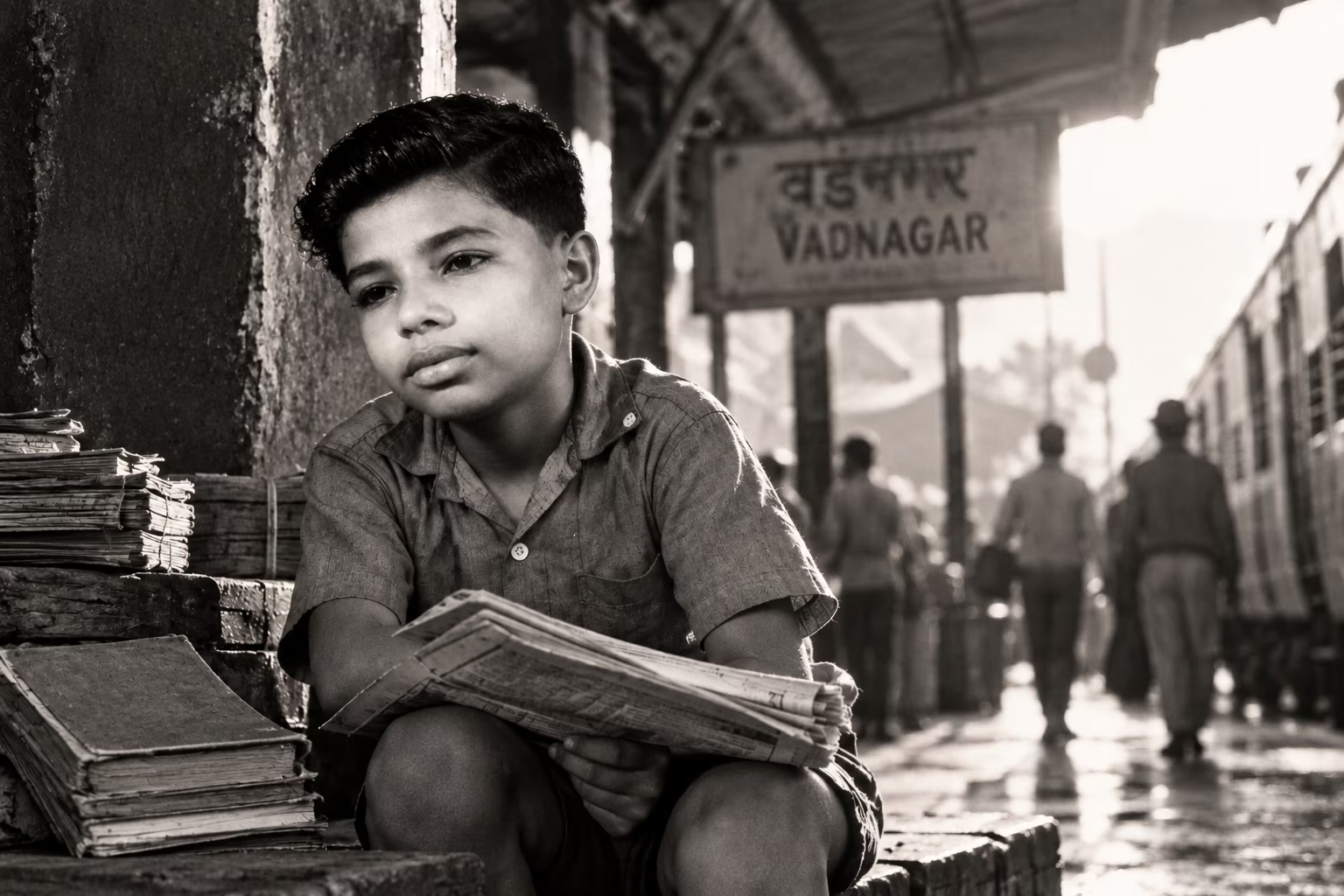
He says he learned Hindi while serving tea to traders at a railway station. As a teenager, he left home and spent about two years travelling around India. And long before he became Prime Minister, books, teachers, spirituality and the history of his hometown had already become important parts of his life.
On his 76th birthday, here are 10 facts and lesser-known details from his journey, drawn mainly from records and interviews published by the Prime Minister’s Office and other official sources.
- He is the first Prime Minister of India to be born after Independence
Narendra Modi was born on September 17, 1950, in Vadnagar, then a small town in Gujarat’s Mehsana district. India had become independent only three years earlier.
That makes Modi the first Indian Prime Minister born in independent India. The distinction is a simple date in the history books, but it also places his personal timeline inside a different generation from all the Prime Ministers who came before him.
He was the third child of Damodardas Modi and Hiraba Modi. According to the official PMIndia biography, his family lived in a modest single-storey house measuring approximately 40 feet by 12 feet.
That small measurement is one of the more striking details in the official account of his childhood because it gives a physical sense of the environment in which he grew up rather than simply describing his family as poor.
- A spiritual journey began long before he entered public life
Politics was not the only direction Modi has described for himself in his younger years.
In accounts of his early life, Modi has spoken about his interest in spirituality and the influence of Swami Vivekananda. The official PMIndia biography says Vivekananda’s writings had a strong influence on him and helped shape his interest in spiritual life.
Another important figure in that journey was Swami Atmasthananda of the Ramakrishna Mission. Modi has recalled spending time with him and said his guidance played an important role in shaping his understanding of service.
In a later conversation, Modi described his travels in the Himalayas and his encounters with saints as part of a personal search to understand life and his own purpose. He also spoke about the influence of Swami Atmasthananda and the Ramakrishna Mission on his outlook towards service.
This part of his story is less visible than the familiar political journey. Long before he became Chief Minister or Prime Minister, Modi has described his search as something personal — an attempt to understand life, spirituality and what he should do with his own life.
- He once ran a food stall with friends for flood relief
Another childhood memory is less famous than the tea stall.
In an interview published by the PM’s Office, Modi recalled that he and his friends once set up a food stall and donated the proceeds to help people affected by a local flood.
The episode is part of his own recollection of childhood and should not be confused with a later government relief programme. It was a small initiative by school-age friends, but it is one of the unusual details he has mentioned when speaking about his early years.
It also adds another layer to the familiar childhood narrative. The early story was not only about earning money at the family tea stall. According to his recollection, there were also moments when he and his friends tried to raise money for people facing hardship.
- At 17, he left home and spent about two years travelling
One of the biggest turning points in Modi’s personal story came when he was still very young.
According to his official biography, he left home at the age of 17 and spent about two years travelling across India. The account says he travelled through different parts of the country and encountered different cultures before returning with a clearer sense of direction.
In a later conversation with entrepreneur Nikhil Kamath, Modi described the decision in more personal terms. He said leaving home at such a young age meant losing contact with many childhood friends and people he had known.
Years later, after becoming Gujarat Chief Minister, he invited around 30 to 35 of his old school friends to the Chief Minister’s residence. He recalled that the reunion was not quite what he had imagined because the friends now saw him through the position he held rather than simply as the boy they had known.
That detail makes the story more human. Political office can change how people see a person, but old friendships do not necessarily return to the way they were before.
- He described himself as an average student
Modi’s own description of his school years is different from the image of a conventional academic achiever.
In a conversation published by the PM’s Office, Modi described himself as an average student who was not particularly noticed. He said he was not interested in competition and preferred different activities, while also saying he could quickly pick up new things.
The same official account records the role of one of his teachers, Veljibhai Chaudhary, who Modi said saw potential in him and often spoke about his abilities to his father.
The official PMIndia biography also says his schoolmates remembered him as industrious, interested in debates and curious about books. It says he spent many hours reading in the local library and was fond of swimming.
Modi has also spoken about the role of teachers in his life. During a 2026 interaction with students, he recalled that one of his teachers encouraged students to visit the library and read newspaper editorials before discussing them in class.
- As a young man, he wrote to the Chinese embassy about Xuanzang
This is one of the more unusual stories from his early years.
In a conversation with Nikhil Kamath, Modi recalled that he had read about the Chinese Buddhist monk and traveller Xuanzang, who had visited Vadnagar centuries earlier. When he heard that a film was being made about Xuanzang, he said he wrote to the Chinese embassy about the historical connection with his hometown.
The historical connection itself is independently documented. A PMIndia release on Modi’s visit to China in 2015 noted archaeological and historical evidence linking Vadnagar with Xuanzang’s travels. It said Xuanzang had referred to the place as Anandpur and that ancient Vadnagar had been an important Buddhist centre.
This is an interesting window into how Modi viewed his hometown even as a young person: not simply as the place where he was born, but as a location with a much older history.
- His connection with teachers did not end with school
After becoming Gujarat Chief Minister, Modi made a point of bringing some of his old teachers together.
In the Nikhil Kamath conversation, he recalled searching for teachers who had taught him from his childhood through school. He said he invited around 30 to 32 teachers and publicly honoured them. One of the oldest teachers present was around 93 years old at the time.
He also spoke about inviting old school friends, extended family members and families who had provided him meals during his early years of organisational work.
The significance of the episode lies less in the ceremony itself and more in what it reveals about the distance between his early life and the position he later occupied. By then, people who had known him as a child were meeting him as the Chief Minister of Gujarat.
- His academic qualification is a master’s degree in political science
The childhood story is often told through the image of the tea stall, but his education continued well beyond his school years.
The official PMIndia profile states that Modi completed a master’s degree in political science from Gujarat University.
The detail is worth including because the popular shorthand around his early life can sometimes make the journey sound as though his education stopped with his childhood. It did not.
His official profile records both his early years of work and his later academic qualification, providing a fuller picture of the educational path that accompanied his professional journey.
- An Indian proposal for International Yoga Day reached the United Nations with record backing
One of the international milestones associated with Modi’s tenure began with an idea he put forward at the United Nations.
In his address at the opening of the 69th session of the UN General Assembly in 2014, Modi proposed an International Day of Yoga. The United Nations later adopted Resolution 69/131 on December 11, 2014, declaring June 21 as the International Day of Yoga.
The UN says the proposal was endorsed by a record 175 member states. That is the figure that should be used rather than larger numbers sometimes repeated elsewhere.
The episode is significant because the proposal for an International Day of Yoga was formally taken up by the United Nations and adopted by the General Assembly. The documentary record is clear: Modi introduced the idea at the UN, India proposed the draft resolution and it was endorsed by 175 member states.
- In 2026, he crossed a record for continuous service as an elected Prime Minister
There is another milestone that arrived only a few months before his 76th birthday.
On June 10, 2026, the Union Cabinet passed a resolution stating that Modi had become India’s longest-serving elected Prime Minister by consecutive days in office. According to the resolution, he reached 4,399 days of continuous service as an elected Prime Minister, crossing Jawaharlal Nehru’s previous record of 4,398 continuous days between 1952 and 1964.
This is an official government record and should be presented that way. It is different from saying that Modi has been India’s longest-serving Prime Minister in every possible measure. The specific distinction made by the Cabinet is “longest-serving elected Prime Minister” for consecutive days of service.
That distinction matters in journalism because records involving political office can be measured in different ways. The exact wording of the official claim keeps the fact precise.
At 76, Narendra Modi’s public life now spans more than seven decades, from a childhood in Vadnagar to the country’s highest executive office. The distance between those two points is easy to describe in a sentence, but the details tell a more complicated story.
There is the small family house in Vadnagar, the railway station where he helped sell tea, the conversations through which he says he learned Hindi, the books he read in the local library and the decision to leave home at 17. There is the young man who travelled across India, the student who remembered his teachers and the adult who later brought many of those teachers together.
Then came the years of public work, Gujarat’s state leadership and eventually the Prime Minister’s Office in New Delhi. His journey has also produced milestones that extend beyond his personal biography, including the UN’s adoption of International Day of Yoga and, in 2026, the official record for consecutive service as an elected Prime Minister.
The political debates surrounding any Prime Minister are a separate story. A birthday feature does not need to settle them. What can be documented is the path itself where it began, the people and experiences that shaped it, and the milestones that followed.
For a boy who grew up in Vadnagar in the first years of independent India, the distance travelled since then is measured not only in offices held or records reached, but also in the small details that are easy to miss: a railway platform, a library, an old teacher, a letter about a Chinese traveller and a childhood food stall whose earnings went towards flood relief.