




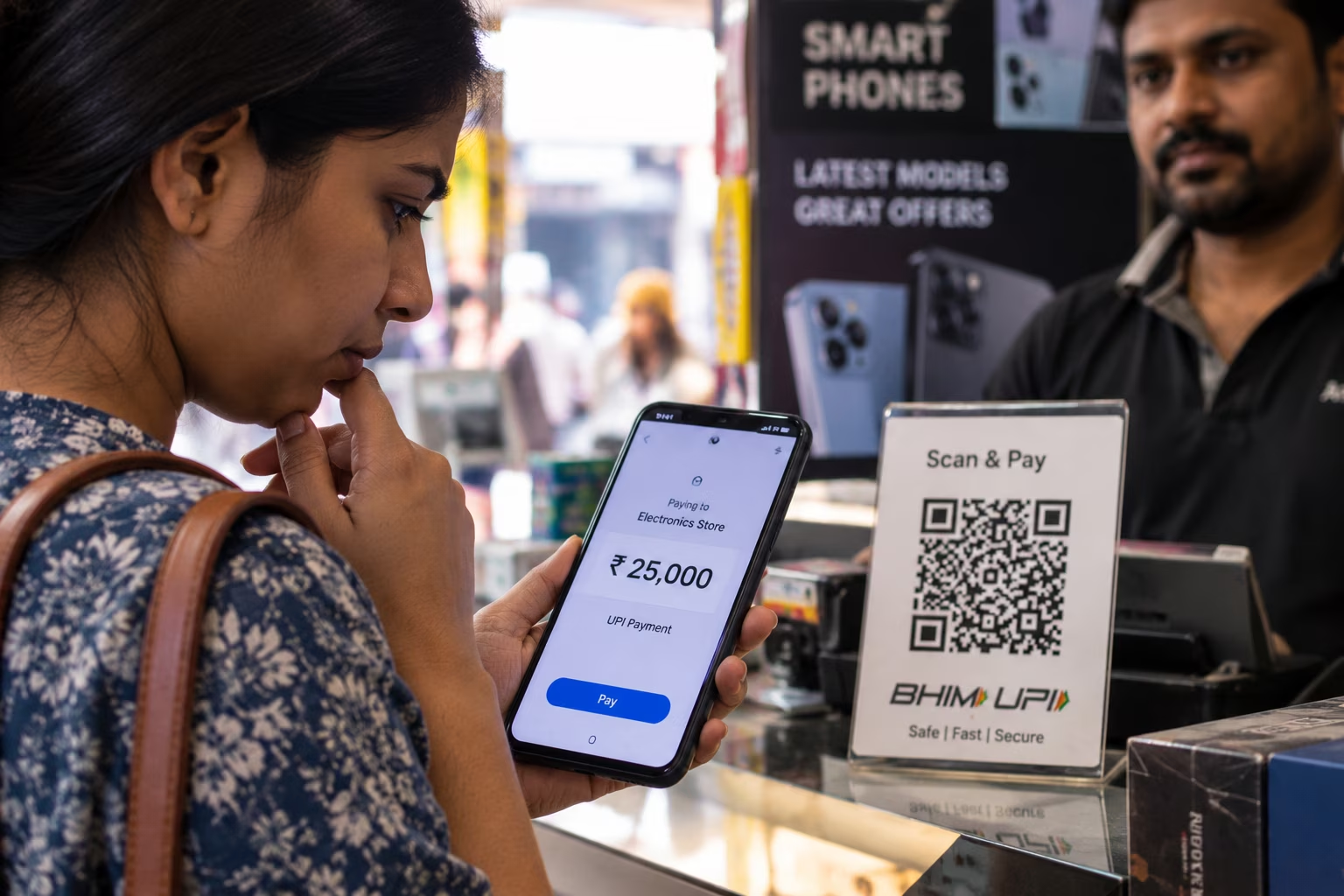
New Delhi: For millions of Indians, paying through UPI has become an everyday habit. A customer walks into a shop, scans a QR code, enters the amount and moves on. There is no cash to count and no card machine to use. Most people rarely think about what happens behind that two-second payment or who pays for the system that makes it possible.
That is set to change from October 15, but not in the way the phrase “UPI charges” might suggest. The new rules do not mean that every person using UPI will suddenly have to pay a fee. The change is mainly about how certain higher-value payments made to merchants are handled and who bears the cost of processing them.
The National Payments Corporation of India, or NPCI, has introduced a Merchant Discount Rate, or MDR, of 0.4% on specified person-to-merchant UPI transactions above ₹2,000. The charge will be capped at ₹300 for transactions of ₹75,000 or more.
For ordinary UPI users, much of the system will remain as it is. Person-to-person transactions will remain free, while merchant payments up to ₹2,000 and transactions covered by the small-merchant zero-MDR framework will also remain free. The Finance Ministry has said around 96% of P2M transactions will remain unaffected by the new MDR.
So, for a customer standing at a shop counter, there may be little visible change after October 15. The difference will largely sit within the payment system, where certain higher-value merchant transactions will now carry a cost.
Take a ₹10,000 purchase. If it falls under the standard 0.4% MDR, the merchant-side charge would be ₹40. On a ₹50,000 transaction, it would be ₹200. The customer would still pay the full amount shown on the bill and the MDR would be deducted within the payment system before the merchant receives the settlement.
That distinction matters for small businesses because the 0.4% figure does not apply to every merchant in exactly the same way. The new framework provides zero-MDR treatment for qualifying small merchants under the P2PM category, while some sectors have separate rates and rules.
Fuel, railways, insurance and telecom, for example, have separate treatment, while certain capital-market transactions are subject to another rate. A small shop taking ₹100, ₹300 or ₹800 payments through UPI is therefore not suddenly facing a 0.4% deduction on every transaction.
The businesses that are more likely to notice the change are those regularly taking larger payments through UPI. An electronics dealer selling a ₹40,000 television, a furniture store collecting ₹60,000 for an order or another business handling high-value transactions will have to account for the MDR where it applies.
For a large company, the amount may simply become another operating expense. For a smaller business working with tighter margins, even a small deduction can matter. A merchant may choose to absorb the cost, adjust margins or take it into account while setting prices.
That does not mean customers will necessarily see a separate “UPI charge” added to their bill. The way an individual business deals with the cost will depend on its category, the transaction and its own pricing decisions.
The bigger change, however, is taking place away from the customer’s phone screen.
UPI may be free to the person making the payment, but running the network at its current scale is not free. Banks, payment service providers and technology companies have to maintain the infrastructure behind each transaction, while fraud monitoring, cybersecurity, settlement systems and network capacity all require continuous investment.
And the scale is now enormous.
NPCI data shows that UPI processed more than 24.5 billion transactions worth nearly ₹29.8 lakh crore in August 2026 alone. What began as a way to encourage Indians to move away from cash has become a central part of the country’s financial infrastructure.
That growth has also created a financial challenge. UPI was deliberately kept free for users and merchants to encourage adoption, with the government supporting the ecosystem through incentives.
But transaction volumes have grown far beyond the levels seen in the early years, raising a larger question about how the banks, payment companies and technology providers involved in the system will meet the cost of maintaining and expanding it.
The new MDR framework is aimed at addressing part of that problem without turning UPI into a service where ordinary users have to pay every time they make a transaction.
The Finance Ministry has clarified that MDR is not a tax collected by the government or NPCI. The money is distributed among participants in the payment ecosystem and is intended to support the operation and continued expansion of UPI.
For the government, the calculation is to keep the consumer experience largely free while creating a revenue mechanism around selected higher-value commercial transactions. The thinking is that a network operating at this scale needs a financial structure that can support investment in technology, capacity and security.
For merchants, the calculation is different. UPI became popular partly because it was cheap and simple to accept. A small retailer could put a QR code on the counter and receive digital payments without the infrastructure traditionally associated with card payments.
Adding a cost to some larger transactions changes that equation, even if the amount involved in an individual payment is relatively small.
For ordinary users, the practical picture from October 15 is fairly simple:
- Sending money to friends or family: No new UPI charge.
- Person-to-person transfers: Remain free.
- Merchant payments up to ₹2,000: No MDR.
- Specified merchant payments above ₹2,000: Standard MDR of 0.4%, subject to the applicable category and rules.
- Transactions of ₹75,000 or more: Standard MDR is capped at ₹300.
- Qualifying small merchants: Continue to receive zero-MDR treatment under the applicable framework.
- Separate UPI fee for customers: The new MDR is not intended to become a customer-facing UPI fee.
The real impact will become clearer once the new rules start operating in everyday business. UPI grew because it removed friction from digital payments. Customers did not have to think about transaction charges before choosing to scan a QR code, while small businesses could accept digital money with very little setup.
That convenience is something the government now has to protect while also dealing with the cost of running a payment network that handles billions of transactions every month.
Consumers will continue to expect UPI to be simple and inexpensive. Merchants will have to see how the new cost fits into their businesses, particularly those handling larger payments. Banks and payment companies, meanwhile, will have to maintain the infrastructure and security needed to keep the system running at its current scale.
So October 15 is not the day UPI suddenly becomes a paid service. It is a change in the economics behind a payment system that Indians have come to use almost without thinking about it.
For most customers, the routine will remain the same: scan the QR code, enter the amount and pay. The difference will be felt mainly on the merchant side, where eligible higher-value transactions will now carry a cost, and within the payment ecosystem that has to keep investing in the network as its use continues to grow.
That is ultimately what the October 15 change is about. UPI is no longer a new payment experiment that needs to be made attractive to Indians. It has become part of everyday life, from a small roadside shop to a large retail store.
The next challenge is to keep the system simple, reliable and widely accessible while building a sustainable model to support its continued growth.