





BHUBANESWAR: A new Odisha government policy on outsourcing has changed the way departments will engage workers through private service providers, with the Finance Department directing that future requirements be assessed in terms of “man-hours” rather than “manpower.” The policy also bars the creation of fresh posts specifically for outsourcing services, putting the future of existing outsourced workers under greater scrutiny as their current contracts expire.
The policy position was communicated through a September 24 letter from the Labour Department to the Labour Commissioner. The letter, signed by Labour Department Deputy Secretary Piyush Ranjan Parida, says no new posts will be created for outsourcing services. Departments have instead been asked to clearly define the service they require before engaging a service provider.
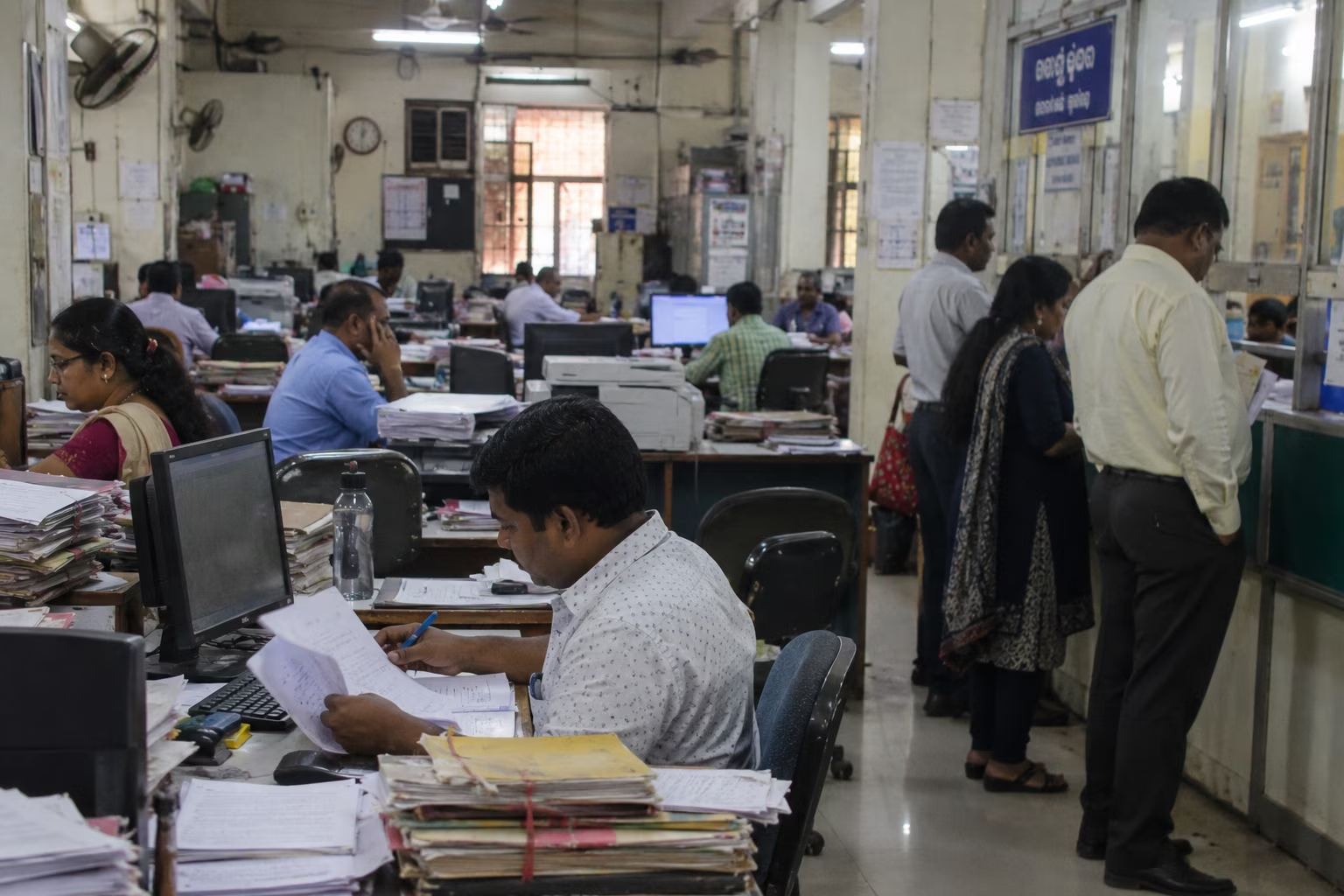
The change matters because outsourcing has become a regular part of government functioning in Odisha. People hired through service providers work in areas such as office support, data entry, cleaning, security and other services. Under the new approach, departments will focus on the work that needs to be delivered rather than simply asking an agency to provide a fixed number of workers.
For example, if a department needs cleaning services, its requirement could specify the total area, number of rooms and the number of employees using the premises. The service provider would then determine the workforce and working hours required to deliver that service.
What does it mean for existing outsourced workers?
The new policy does not automatically mean that every existing outsourced worker will lose their job immediately. The immediate situation will depend on the existing contract in each department and when that contract expires.
However, the policy could create uncertainty when existing contracts come to an end. Departments have been directed to invite tenders early enough to select a new service provider before the current contract expires. If another agency takes over, the continuation of individual workers could depend on the terms of the new contract and the agency’s requirements.
This is particularly important for workers who have spent several years doing the same duties in government offices. They may continue performing similar work, but their employment relationship remains with the outsourcing agency rather than the government.
The new policy also requires comprehensive agreements with service providers and says the scope of outsourced work should be clearly defined. Such agreements are intended to prevent future claims seeking regularisation of outsourced workers as government employees.
The contract period will be limited to two years, with a possible one-year extension if the agency’s performance is satisfactory. Under the new policy, the total contract period cannot exceed three years. Departments have also been told to begin the tender process in advance so that a new agency can be selected before the existing contract ends.
That means workers could face greater uncertainty around continuity when one outsourcing contract ends and another begins. Whether an existing worker continues could depend on the new agency, the work requirement and the conditions included in the fresh tender.
Why is the government changing the system?
The new model is intended to make outsourcing more closely linked to measurable services. Instead of departments treating outsourced employees as a fixed pool of manpower, they will define the work and calculate the number of hours or level of service required.
The approach also gives departments a clearer framework for evaluating what they are paying for. A service provider would be responsible for delivering the specified work under the contract, rather than simply supplying a predetermined number of people.
The policy also says government offices will not issue identity cards to outsourced employees. Where identification is necessary, the service-provider agency may issue cards to its own employees.
How many outsourced workers are there in Odisha?
One of the biggest difficulties is that the government does not appear to have a single consolidated figure covering all outsourced workers across departments and districts.
During the Monsoon Session of the Odisha Assembly, MLA Pratap Keshari Deb asked how many outsourcing employees were engaged from the district level to the Secretariat and how many had been retrenched. Chief Minister Mohan Charan Majhi said outsourced personnel were temporarily engaged through service providers and were not government employees, and therefore consolidated data was not maintained. He cited 137 outsourced employees under the General Administration Department.
In another Assembly response, Health Minister Mukesh Mahaling said more than 50 service-provider agencies were working across all 30 districts in the Health Department.
The State Outsourcing Association claims that more than 50,000 outsourced employees are working across Odisha. Association president Sanjay Kumar Patnaik has alleged that workers are facing retrenchment, including people who have performed government-related duties for many years. The 50,000 figure is an association estimate, not a consolidated government figure.
What happens when a contract changes?
For an outsourced worker, the most important point may be what happens at the end of the current contract.
Suppose a person has been working as an office assistant in a government establishment for several years. If the existing service-provider contract expires, the department may select another agency through a fresh tender. The new agency could be responsible for providing the required service under the new contract.
The worker may therefore continue if the new arrangement requires the same service and the agency retains or recruits the person. But the policy does not create a government post for that worker, and long service by itself does not establish government employment.
This distinction becomes more important because the new agreements are specifically intended to prevent claims for regularisation.
The government has also previously maintained that outsourced personnel engaged through service-providing agencies are different from contractual government employees. Odisha’s existing financial rules treat outsourcing as procurement of defined services, including cleaning, housekeeping, security, maintenance and other support services, rather than direct government employment.
A change that could affect both departments and workers
For the government, the new system provides a more service-based way of planning outsourcing requirements. Departments can specify the work, estimate the required man-hours and invite agencies to compete for the contract.
For workers, the situation is less straightforward. A person may continue doing the same work inside the same government building, but the employer and contractual arrangement can change when the service provider changes.
The policy therefore does not amount to an immediate statewide termination of outsourced employees. Its significance lies in what happens over time, particularly as existing contracts expire and departments move to the new model.
The government has also directed departments to start tender procedures early enough to ensure that a replacement agency is selected before an existing contract ends.
For thousands of outsourced workers, that transition will be closely watched. Their immediate concern will be whether their current work continues, whether a new agency takes over the service and whether they are retained under the new arrangement.
The shift from “manpower” to “man-hours” may sound like a technical change in government procurement. For people whose monthly income depends on outsourced employment, however, the real question is much more direct: when the current contract ends, will the job continue with them?