



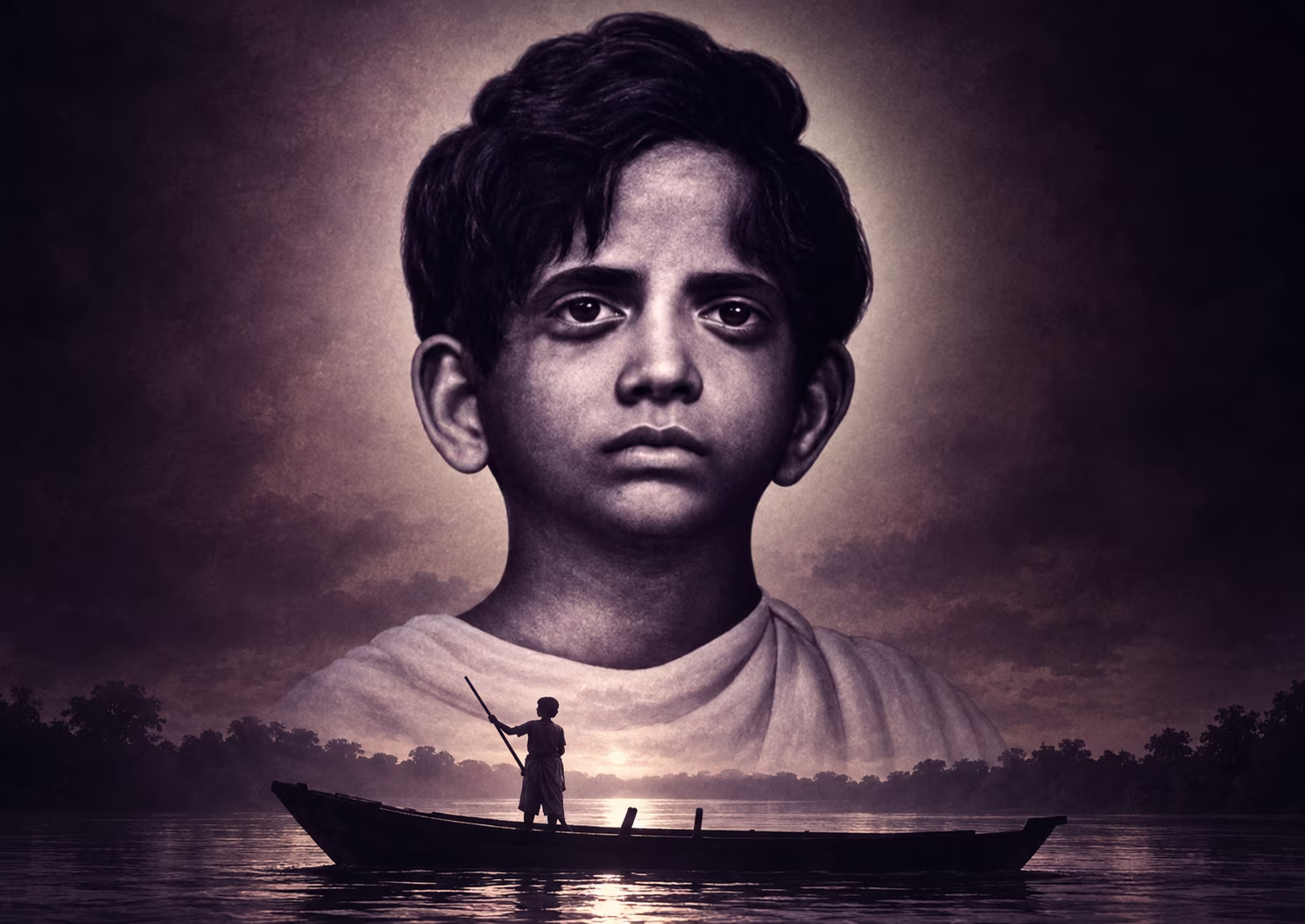
DHENKANAL: A hundred years after his birth, the name of Baji Rout still carries the weight of a story that began with a small boat on the Brahmani River and ended with the death of a 12-year-old boy.
Born on October 5, 1926, at Nilakanthapur in Dhenkanal, Baji Rout grew up in a poor family. His father, Hari Rout, died when he was young, and his mother, Rania Devi, struggled to support the family by grinding and husking paddy. Baji had little formal education and worked as a boat boy on the river.
Yet the circumstances of his childhood brought him close to the political unrest of the time. Dhenkanal was witnessing a growing Prajamandal movement against the oppressive rule of the princely state’s ruler, and young people were also being drawn into the struggle. Baji became a member of the Banar Sena, a youth group associated with the Prajamandal movement.
Among the leaders of the movement was Baishnab Charan Patnaik, who played an important role in organising resistance in Dhenkanal. The Banar Sena involved children and young people who helped the movement by carrying messages, keeping watch and observing the movements of the authorities. Baji was one of them.
The situation in Dhenkanal had become increasingly tense by 1938. Government records describe a period of severe repression as authorities attempted to suppress the Prajamandal agitation. Villages were raided and people faced violence and intimidation.
The events that led to Baji Rout’s martyrdom unfolded over the night of October 10-11 and into the early hours of October 12, 1938. Bhuban was an important centre of the Prajamandal movement. On October 10, a police party led by magistrate Binay Ghosh arrested several protesters and shot two villagers. Later, at midnight on October 11, the police party moved towards Dhenkanal with the arrested protesters and attempted to cross the Brahmani River at Nilakanthapur.
Baji Rout was among the young members of the Banar Sena keeping watch at Nilakanthapur Ghat. When the armed British police reached the river and demanded the village boat, he refused to ferry them across. The Banar Sena had received advance information about their movement and had detained the boat to prevent the police from crossing the river.
The confrontation soon turned violent. According to the Ministry of Culture’s account, a scuffle broke out at dawn on October 12 as the police tried to take control of the boat. Nearly a dozen villagers, including Baji and his brother, held on to it to prevent the police from using it. The police opened fire, killing Baji and several other villagers and injuring others. Baji was only 12 years old.
His death was shocking because of the sheer contrast between his age and the force he had been willing to face. He was not a soldier carrying a weapon. He was a village boy whose work was connected to the river, standing beside a boat at a time when his community was caught in a much larger political struggle.
His courage was also rooted in the world around him. He had seen poverty in his own home and the pressure faced by ordinary families. Government accounts record that he witnessed the actions of police and officials and the economic hardships imposed on people under the prevailing system.
That background helps explain why the Prajamandal movement meant something to children like Baji. For them, the struggle was not simply an abstract political campaign. It was connected to the lives of their families, their villages and the conditions in which they grew up.
The sacrifice of Baji Rout soon travelled far beyond Nilakanthapur.
His body and those of other victims were taken in procession, and the killings created widespread anger. His martyrdom became a symbol of the resistance in Odisha. The story also entered literature through the work of poet Sachidananda Routray, whose poem on Baji Rout helped preserve the memory of the young martyr. The Ministry of Culture notes that his bravery and patriotism were immortalised in Routray’s poem “Boatman.”
Routray’s literary remembrance gave Baji’s story another life. The boy who had stood beside a river in a small village became part of Odisha’s wider cultural memory.
A century after his birth, the state continues to remember him. On October 5, 2026, Odisha Chief Minister Mohan Charan Majhi paid floral tribute to Baji Rout at the Odisha Legislative Assembly premises during the state-level Jayanti observance, describing him as the nation’s youngest martyr.
But the meaning of Baji Rout’s story goes beyond a birth anniversary or a chapter in a history book.
His patriotism was expressed through an act that was very simple to understand: when armed police demanded the boat, he refused to cooperate with them. He had very little power, but he understood that the choice placed before him mattered to the people around him.
That is what gives his story its human depth, baji did not live to see India become independent in 1947. He did not see the national flag rise over a free India or experience the freedom for which generations of Indians had struggled. His life ended nine years before independence.
Yet his sacrifice became part of the history that led to that freedom.
For Odisha, Baji Rout remains more than the name of a young martyr. He represents the courage of ordinary people who entered the freedom struggle without armies, wealth or political power. His weapon was his willingness to stand by the decision entrusted to him, even when the consequences were deadly.
At 12, Baji Rout had almost an entire life ahead of him. Instead, he became one of the youngest symbols of India’s freedom struggle.
His story survives because the courage of a child on the banks of the Brahmani became larger than the moment in which he died. It became a reminder that the love of a motherland can take many forms sometimes through a movement, sometimes through a message carried from one village to another, and sometimes through a boy who simply refuses to give up the boat.