





India’s Agni missile programme began at a time when the country was still trying to establish the basic technologies needed to design and manufacture advanced missiles on its own. More than three decades later, the programme has reached a much more sophisticated stage, with India publicly demonstrating Multiple Independently Targetable Re-entry Vehicle, or MIRV, technology.
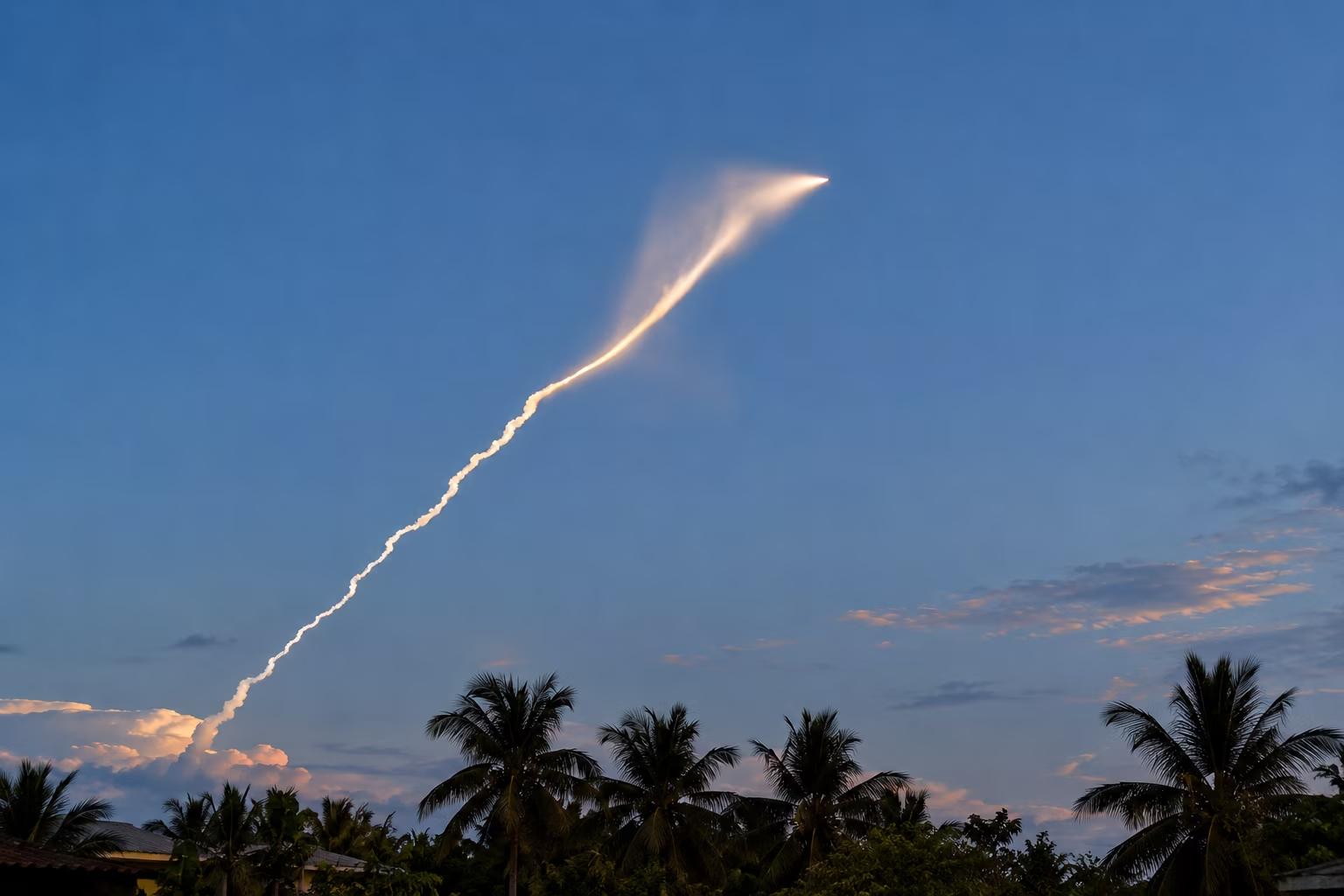
The latest officially confirmed Advanced Agni MIRV trial took place on May 8, 2026, from Dr APJ Abdul Kalam Island in Odisha. The Ministry of Defence announced the successful flight test the following day, saying the missile carried multiple payloads aimed at different targets spread across a large geographical area in the Indian Ocean Region. Ground and ship-based tracking stations monitored the flight from launch through the impact of the payloads, and the government said the flight data confirmed that all mission objectives had been met.
The development is the latest stage of a programme that started in the 1980s and involved generations of Indian scientists, engineers, defence personnel and industrial partners. Among the central figures in its early development were Dr V.S. Arunachalam, Dr APJ Abdul Kalam and Dr Ram Narain Agarwal, whose roles covered the programme’s scientific leadership, organisation and missile development.
The foundation was laid in 1983, when the Government of India sanctioned the Integrated Guided Missile Development Programme, or IGMDP. According to a DRDO historical account, Dr V.S. Arunachalam became Scientific Adviser to the Raksha Mantri in 1981, while Dr APJ Abdul Kalam took over as Director of the Defence Research and Development Laboratory in 1982. Kalam added a fifth proposal to four earlier tactical missile projects: a technology demonstrator for a re-entry vehicle. The five proposals became Prithvi, Trishul, Akash, Nag and Agni and were brought together under the IGMDP, which was sanctioned in July 1983 by Prime Minister Indira Gandhi.
Kalam had already worked on India’s space programme before moving into missile development. His experience with launch vehicles became valuable as India began applying its knowledge of rockets, guidance and control systems to defence. Dr Ram Narain Agarwal became the Project Director of the Agni programme in 1983 and led its development for more than two decades. DRDO later described him as a pioneering figure in the programme and credited him with leading the technology demonstrator through its first successful test.
The first Agni test came on May 22, 1989, from the Integrated Test Range at Chandipur in Odisha. DRDO describes the launch as the maiden test of the Agni re-entry technology demonstrator. The test was important because it allowed Indian scientists to demonstrate technologies associated with re-entry, guidance, control and propulsion that would form the basis for later developments.
A modern strategic missile can appear deceptively simple from a distance. It is a long cylindrical vehicle that rises into the sky and follows a planned trajectory. Inside, however, are propulsion systems, computers, navigation equipment, control systems and structures designed to withstand enormous forces and extreme temperatures.
India had to develop these technologies through years of research, testing and refinement. The Agni family expanded into different ranges and configurations, while propulsion, guidance, navigation, composite materials and launch systems continued to improve. Later systems also moved towards road mobility and canisterised launch arrangements.
For a strategic missile, range is only one part of the challenge. Reliability and the ability to control the missile throughout its flight are equally important. Navigation has to remain accurate, the structure must withstand severe acceleration and vibration, and the re-entry vehicle has to survive the intense heating encountered when it returns through the atmosphere.
The heat generated during re-entry is one of the major engineering problems. During an Agni-IV flight test in 2012, the Ministry of Defence reported that the re-entry heat shield withstood temperatures above 3,000 degrees Celsius while keeping the internal avionics below 50 degrees Celsius. The test also demonstrated advanced avionics, onboard computing and navigation technologies.
The programme’s development eventually moved beyond the question of how far a missile could travel. MIRV technology introduced a different challenge.
MIRV stands for Multiple Independently Targetable Re-entry Vehicle. A conventional ballistic missile can carry a principal re-entry vehicle towards its intended target, while a MIRV-equipped system can carry multiple re-entry vehicles that can be directed towards different target locations. The technology requires accurate navigation, sophisticated control and a system capable of releasing the re-entry vehicles at the appropriate stage of flight. Each vehicle must then follow its intended trajectory and survive atmospheric re-entry.
India publicly demonstrated this capability in March 2024 through Mission Divyastra. DRDO described it as the first successful flight test of an indigenously developed Agni-5 missile with MIRV technology. The test was conducted from Dr APJ Abdul Kalam Island, while telemetry and radar stations tracked and monitored multiple re-entry vehicles.
Prime Minister Narendra Modi praised the scientists involved on March 11, 2024, writing: “Proud of our DRDO scientists for Mission Divyastra, the first flight test of indigenously developed Agni-5 missile with Multiple Independently Targetable Re-entry Vehicle (MIRV) technology.”
The May 2026 trial demonstrated the technology again on an Advanced Agni platform. The Ministry of Defence said multiple payloads were targeted towards different locations over a large geographical area and that tracking systems monitored the complete trajectory. The ministry also said the missile was developed by DRDO laboratories with support from industries across the country.
Defence Minister Rajnath Singh congratulated DRDO, the Indian Army and industry after the test, saying the trial “will add an incredible capability to the country’s defence preparedness against the growing threat perceptions.”
The official statement does not identify the exact Agni variant used in the May 2026 MIRV trial. That distinction matters. Social-media claims identifying the missile as Agni-6, or assigning a particular range or exact payload configuration to it, should not be presented as confirmed information unless an official source establishes those details.
The technology has a direct connection with India’s strategic deterrence. The Ministry of External Affairs states that India is committed, under its nuclear doctrine, to maintaining credible minimum deterrence with a posture of no-first use.
In that framework, strategic delivery systems are intended to provide India with a credible response capability in the event of a major strategic attack. MIRV technology potentially increases the number of target locations that can be addressed by a single missile system, adding another layer to strategic planning.
That does not mean a missile programme can make a country completely secure in a war. Modern national defence depends on a much wider network involving aircraft, naval forces, submarines, satellites, intelligence, air and missile defence, conventional weapons and command-and-control systems.
A major part of the Agni story is also India’s effort to build these capabilities domestically. A sophisticated missile requires specialised materials, propulsion systems, electronics, navigation equipment, computers, precision manufacturing and testing infrastructure, bringing together expertise from many laboratories and industries.
The May 2026 test therefore also has significance for India’s defence manufacturing sector. The government’s statement that DRDO laboratories developed the missile with support from industries across the country shows how the programme has become connected to a wider domestic manufacturing base.
This is where the programme connects with the idea of Make in India and defence self-reliance. The objective is not simply to assemble a missile domestically. It is to develop the ability to design critical systems, manufacture specialised components, test them, analyse the results and improve the next generation without depending entirely on overseas technology.
Over the years, that process has created expertise in areas such as propulsion, composite materials, electronics, navigation, guidance and high-precision manufacturing. Those capabilities can support other aerospace and defence programmes as well.
Odisha has remained an important part of this development. Chandipur and Dr APJ Abdul Kalam Island have hosted major Indian missile tests for decades, including Mission Divyastra in 2024 and the Advanced Agni MIRV trial in May 2026.
The programme is also still active across different generations. On August 6, 2026, India successfully test-fired an Agni-4 ballistic missile from the Integrated Test Range at Chandipur. The Ministry of Defence said the launch validated all operational and technical parameters and that the test was conducted under the aegis of the Strategic Forces Command.
The international significance of the MIRV development also needs some context. MIRV is not an Indian invention, nor is India the only country with such technology. The United States, Russia, China, France and the United Kingdom have developed strategic missile systems associated with MIRV technology. Their systems differ in design, range, launch platforms and strategic roles, so there is no meaningful single ranking that can establish one missile as the “world’s most advanced.”
India’s progress is better understood through the technology it has demonstrated. The country that began the Agni programme as part of a broader indigenous missile effort in the 1980s has since developed increasingly complex propulsion, navigation, guidance, mobility and re-entry technologies and has publicly demonstrated MIRV capability through successive tests.
The May 2026 trial was another stage in that development. It showed that India’s strategic missile programme has moved into a level of complexity where one missile system can be tested with multiple payloads intended for different target locations, while the wider programme continues through further testing such as the August Agni-4 trial.
For a programme that began with the first Agni test in Odisha in 1989, the change is visible not only in the missiles themselves but also in the scientific and industrial capabilities that now support their development.