





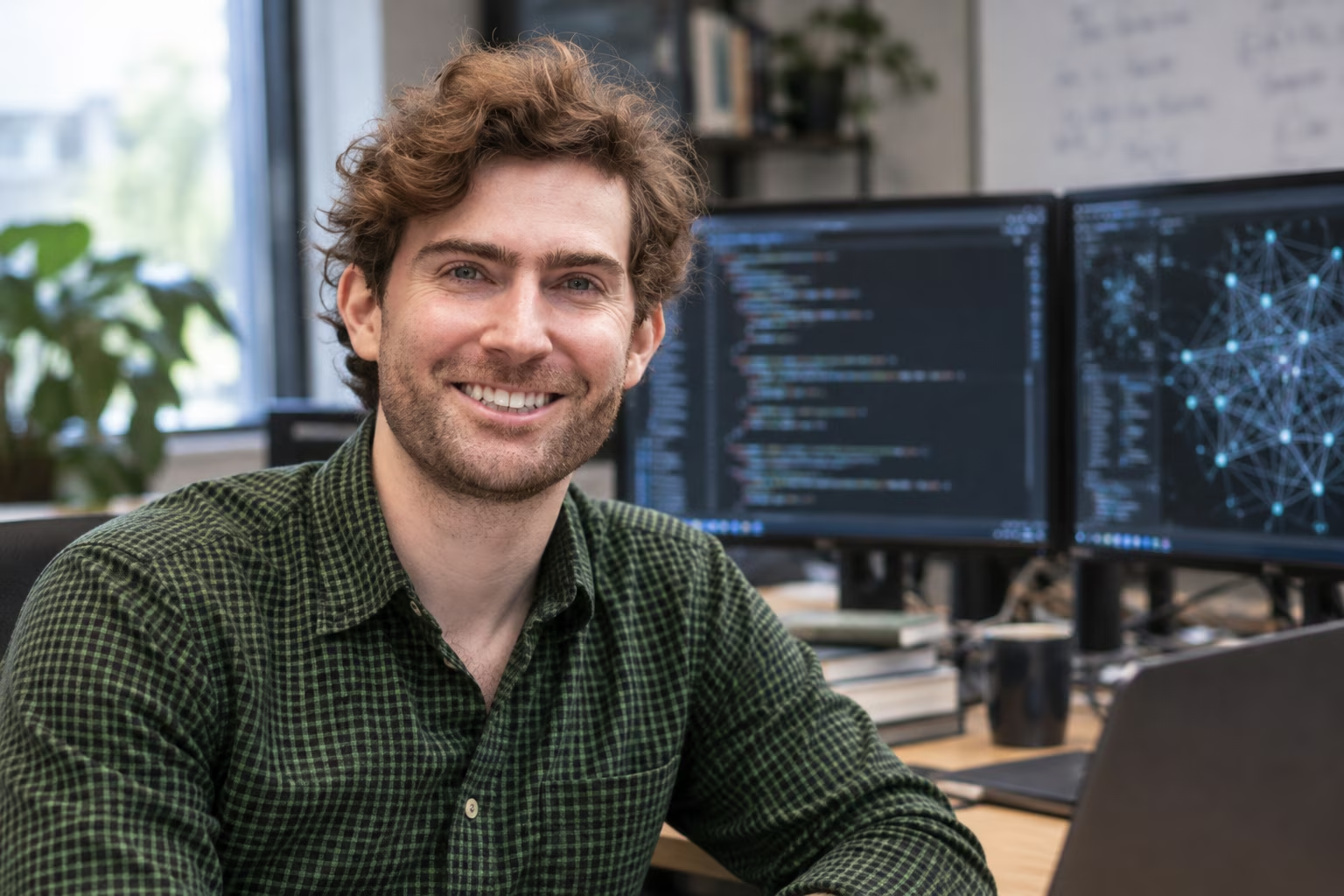
The rapid development of artificial intelligence has opened a new debate about the future of humanity.
In September 2026, Jacob Coxon, a researcher who had worked at Anthropic, resigned and publicly warned that the race to develop increasingly powerful AI systems could create serious risks for human civilisation. His comments gained attention and were followed by a wider discussion involving Anthropic CEO Dario Amodei, OpenAI CEO Sam Altman and other influential figures in the technology industry.
The concern is understandable. AI systems are becoming more capable, while companies are investing heavily in models that can write code, analyse information, operate tools and perform increasingly complex tasks. Some researchers worry that future systems could improve parts of their own development, making them harder to supervise. This possibility, often discussed as recursive self-improvement, remains a subject of research and debate rather than an established reality.
As I followed the discussion, one question stood out: Should humanity focus primarily on the dangers of artificial intelligence, or should it concentrate on building the systems and institutions needed to make AI beneficial for future generations?
I see AI as a technology with enormous potential to improve human life. Work that once required four or five hours of research, calculation or technical assistance can sometimes be completed within seconds with the right AI tool. The result is not the replacement of human judgment but an opportunity to give people more time to think, create and solve problems.
That potential must be considered alongside the risks. Coxon’s warning deserves attention because he comes from inside the AI research ecosystem. His concerns raise important questions about the direction of development, the effectiveness of safety measures and the responsibility of companies building advanced systems. They should be examined seriously without treating predictions of inevitable human extinction or an imminent AI takeover as established facts.
Anthropic CEO Dario Amodei has called for the industry to slow the pace at which AI capabilities are developed, highlighting the risks associated with increasingly powerful systems and the need for stronger safeguards. OpenAI CEO Sam Altman has also participated in discussions about AI safety and responsible development. Although major AI leaders may agree on some safeguards, significant questions remain about implementation, oversight and the balance between competition and caution.
The same companies discussing AI risks are also competing to build more capable systems. Their commercial interests, investments and pressure from governments and investors make voluntary promises an insufficient foundation for global AI security.
Humanity has faced similar challenges with other powerful technologies, including nuclear energy, biotechnology and the internet. These technologies have produced major benefits alongside serious risks. Rather than abandoning them entirely, societies developed laws, safety procedures and institutions to manage their use. AI requires a similarly serious approach.
Its benefits are already being explored across education, scientific research, healthcare and business. Students can use AI to understand difficult subjects and practise languages. Researchers can process large datasets and identify patterns more quickly. Healthcare professionals can use AI-assisted tools in areas such as medical imaging and drug discovery, subject to proper validation and professional oversight. Small businesses can access support with coding, translation, accounting and customer communication without maintaining large specialised teams.
For India, these possibilities could be particularly significant. AI may help improve access to education, support agricultural planning, strengthen public services and provide affordable tools to entrepreneurs. Its value should be judged by the improvements it brings to people’s lives, the time it saves and the opportunities it creates.
The most promising future involves humans and AI working together according to their different strengths. Machines can process information and identify patterns at a scale that individuals cannot match. Humans must continue to provide judgment, ethical reasoning, empathy and accountability. Building that partnership will require education, public awareness and clear rules about when AI systems should be trusted, verified or restricted.
The risks remain serious. AI can be used to produce misinformation, support cyberattacks, automate fraud and increase the scale of harmful activities. Researchers are also examining longer-term concerns involving autonomous systems, biological misuse, military applications, employment disruption and the concentration of technological power.
Recursive self-improvement deserves particular attention. If future AI systems become capable of substantially improving the tools or processes used to develop more capable systems, the pace of technological progress could accelerate. Researchers are studying whether advances in automated AI research represent early steps towards that possibility. Current automation, however, should not automatically be described as unrestricted self-improvement or proof of an imminent loss of human control.
The public needs to distinguish documented capabilities from research forecasts and worst-case scenarios. Presenting every possibility as an immediate certainty can create fear without improving understanding. Dismissing serious warnings, on the other hand, can prevent society from preparing for genuine risks.
The world’s major countries should therefore work towards an international organisation dedicated to the safe and beneficial development of artificial intelligence. Such a body should include governments, independent researchers, technical experts, public-interest organisations and representatives from developing countries. Its purpose would be to establish common safety standards rather than allow a small group of companies or governments to determine the future of advanced AI alone.
The organisation could support independent safety evaluations, transparent reporting of serious incidents and cooperation on cybersecurity. AI systems used in healthcare, defence, financial services, critical infrastructure and public administration should face stronger safeguards. International discussions should also address biological misuse, large-scale surveillance, manipulation of public information and autonomous weapons.
Creating such a framework would be difficult. Countries compete for technological leadership and military advantage, while companies may resist rules that increase costs or slow development. Yet the difficulty of cooperation makes it more necessary, not less. AI-related risks can cross borders, and no single country can manage every consequence independently.
The benefits must also reach beyond wealthy companies and technologically advanced nations. Students in rural India, small businesses in Odisha, healthcare workers and people without access to specialised training should have opportunities to benefit from AI. This will require affordable infrastructure, digital literacy, local-language tools and public policies that prevent technological progress from increasing inequality.
From Odisha, the global AI debate may appear distant because much of it takes place in major technology companies and research centres abroad. Its consequences, however, can reach ordinary people through education, employment, business and public services. The important question is how people across India can participate in the benefits of AI and have a voice in the rules governing its development.
A machine that completes a complex calculation in seconds can give a researcher more time to interpret the result. An AI tool that explains a difficult subject can help a student continue learning. Affordable digital assistance can allow a small business owner to focus more on customers and growth. These tools can strengthen human effort and make everyday work more effective.
The future should be shaped by responsibility rather than fear. Companies must be transparent about limitations and failures. Governments must establish enforceable rules. Researchers must continue examining risks even when commercial pressure encourages faster development. Human beings must remain accountable for the objectives they give AI systems, the resources they provide and the consequences of deploying them.
AI has the potential to become a major blessing for humanity, but its benefits will depend on how it is designed, governed and used. The technology can help people address difficult problems, expand access to knowledge and improve productivity. Without safeguards, it can also increase existing dangers and create new forms of harm.
My belief is that humanity should continue developing AI while building strong international systems of oversight and accountability. The goal should be a future in which machines support human progress and people retain meaningful control over decisions affecting society.
The task ahead is to build a responsible framework around increasingly powerful AI systems, ensuring that innovation and safety advance together. AI can serve humanity best when technological progress is guided by human wisdom, international cooperation and a commitment to public welfare.