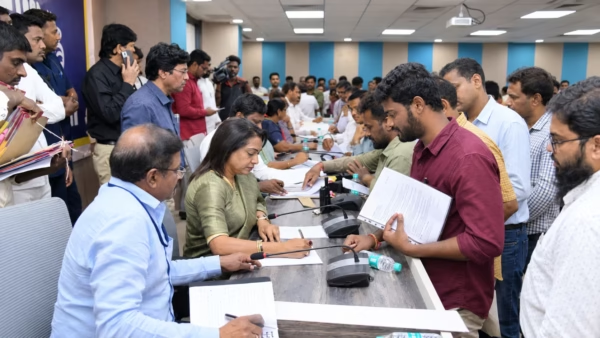




The detention of Cockroach Janta Party (CJP) leaders in Delhi on October 10 has brought a relatively new protest movement into the national political spotlight. Its demand for the resignation of Chief Election Commissioner Gyanesh Kumar over the Special Intensive Revision (SIR) of electoral rolls has raised questions about the movement’s political direction, its support base and the extent to which it holds governments accountable.
Founded on May 16, 2026, by Abhijeet Dipke, CJP emerged from a viral online response to a remark about unemployed young people. It has since moved beyond social media, organising demonstrations over examination irregularities, employment, education and electoral integrity.
The movement has attracted young people frustrated with public institutions and government accountability. Its campaigns have also drawn support from opposition figures, bringing a difficult question into focus: is CJP building an independent public movement, or is it gradually becoming part of the opposition’s wider political strategy?
The answer requires looking at its record, its stated ambitions and the evidence behind the allegations surrounding it.
From a viral post to a protest movement
CJP’s rise followed public anger over examination-related controversies, particularly the NEET-UG paper leak controversy. The movement used social media to mobilise students and young people, turning an online campaign into street protests and negotiations with the Union government.
Abhijeet Dipke became the movement’s most prominent face. Saurav Das and Ashutosh Ranka have also emerged as key figures, serving as co-convenors or spokespersons.
In July, CJP representatives held negotiations with senior Union government figures, including J.P. Nadda, and submitted a memorandum setting out their demands. The discussions placed examination reform and accountability at the centre of the movement’s campaign.
On July 25, 2026, Dharmendra Pradhan resigned as Union Education Minister amid the controversy surrounding the examination system. The resignation was a significant political development during the period of sustained public pressure. Establishing the precise role played by CJP, however, requires separating the wider protest campaign from the actions of any single organisation.
The government subsequently engaged with CJP representatives over their demands. Akashvani reported on July 26 that the government had agreed to consider the movement’s five-point charter on examination reforms. The discussions also covered assurances concerning action against protesters and compensation for families affected by the NEET-UG paper leak.
These talks gave CJP a platform to press its demands directly before the government. The next measure of its influence will be whether the commitments translate into changes that students and families can see.
Source: Akashvani — Third round of talks between Centre and CJP delegation
What has CJP achieved?
CJP’s early impact is visible in its ability to mobilise students, sustain public pressure and secure meetings with government representatives. The July negotiations also showed that authorities were willing to engage with the group and consider its demands.
But the movement’s achievements need to be assessed against the outcome of each campaign. A meeting with ministers is a political opening; a written assurance is a commitment to be tracked; and an implemented reform is a measurable result.
The resignation of the Education Minister came amid the controversy and protests, but the sequence of events alone cannot establish that CJP was responsible for the decision. Public anger, pressure from other groups, parliamentary politics and the government’s own assessment may also have influenced the outcome.
The same standard should apply to the movement’s other campaigns. Its credibility will depend on whether it publishes clear records of the demands it submits, the commitments it receives and the changes that follow. That record would allow students and the public to judge its effectiveness without relying on either supporters’ claims or political opponents’ criticism.
Does CJP challenge BJP governments more often?
CJP’s national profile has grown largely through campaigns directed at the Union government, which is led by the BJP. Its examination-related protests and its October 10 demand for the Chief Election Commissioner’s resignation have therefore placed it in direct confrontation with institutions and authorities at the national level.
That pattern alone, however, is insufficient to describe the movement as exclusively anti-BJP. CJP has also discussed campaigns involving public education, school infrastructure and student issues in different states, including states governed by opposition parties.
The relevant comparison is how consistently it applies its standards. A useful assessment would examine the states where CJP has campaigned, the specific grievances it raised, the officials it held responsible and the action it sought from each government. The intensity of a campaign may vary according to the seriousness of an issue, the response from authorities or the movement’s capacity on the ground.
CJP’s public record should be judged across governments rather than through its most visible confrontations alone. A documented state-by-state record would make it possible to establish whether the movement applies a consistent standard of accountability or gives greater attention to particular political opponents.
Is CJP planning to become a political party?
This is one of the most important questions surrounding the movement.
In an earlier public statement reported in August, Dipke said CJP intended to operate as a pressure group, with no immediate plan to enter electoral politics. That position suggested a movement seeking to influence governments from outside the formal party system.
CJP’s own public-facing material, meanwhile, uses political language and outlines positions on public issues. Its website presents a broader mission and policy agenda, which can naturally prompt questions about its long-term ambitions.
Those two aspects need to be considered separately. A pressure group can campaign on policy, criticise governments, organise nationally and demand resignations without contesting elections. A political party, by contrast, would ordinarily seek an electoral mandate and must meet the relevant legal requirements if it intends to register and contest elections.
As of the information reviewed for this article, there is no verified basis to describe CJP as a registered political party. Nor does its policy agenda alone establish that it has decided to contest elections.
The clearest way to settle the question is a current, direct statement from CJP’s leadership: will it remain a pressure group, or is electoral participation part of its future plan? Until that position is clear, its political ambitions should be described with care.
Reference: Cockroach Janta Party — official website
Opposition support: solidarity or political alignment?
CJP’s campaigns have received attention from opposition leaders and parties. Some opposition figures have supported its demand for accountability over electoral-roll revisions, while the movement’s call for a protest against the Chief Election Commissioner created an opportunity for wider political participation.
Such support does not automatically mean that CJP is controlled by opposition parties. Political organisations frequently join demonstrations or endorse demands that overlap with their own positions. Individuals may also attend protests in a personal capacity rather than as authorised representatives of their parties.
The distinction matters because public support and organisational control are different claims. Evidence of coordination, formal agreements, financial links or decision-making arrangements would be needed to establish a deeper relationship.
The question for CJP is whether it can maintain an independent position when its demands align with those of political parties. An independent movement should be prepared to scrutinise opposition-led governments with the same seriousness that it applies to the Centre.
Foreign funding allegations: what is established?
Allegations about foreign funding have circulated around CJP. Such claims can carry serious implications, particularly when directed at a group involved in political protests. They require documentary evidence rather than repetition on social media.
The Ministry of External Affairs was reported to have said it had “no information to share” in response to questions about the allegations. The specific July statement could not be independently located for this review, so the wording should not be treated here as a directly verified official quotation.
The Delhi High Court also declined to entertain a plea seeking an NIA investigation into the July protest, which the petition linked to allegations of foreign funding; the petitioner withdrew the plea after the court said it was for the government, not the court, to refer such matters to the NIA.
No verified evidence reviewed for this article establishes that CJP received foreign funding. That assessment could change if authenticated financial records, an official investigation or a formal finding by a competent authority emerges.
India’s Foreign Contribution (Regulation) Act sets out the legal framework governing foreign contributions to organisations and individuals covered by the law. The existence of that framework, however, is not evidence that a particular group has violated it.
Official references: Ministry of Home Affairs | FCRA Online Services
The Delhi detentions and the electoral-integrity campaign
On October 10, CJP leaders Abhijeet Dipke, Saurav Das and Ashutosh Ranka were detained in Delhi ahead of a planned protest demanding the resignation of Chief Election Commissioner Gyanesh Kumar over SIR electoral-roll revisions.
The detentions placed the movement’s latest campaign at the centre of a broader debate over protest rights, election administration and public order. CJP’s demand concerns the conduct of a constitutional institution, making the evidence behind its allegations and the remedies it proposes especially important.
The Election Commission of India is responsible for administering elections and overseeing the electoral-roll process under the constitutional and statutory framework. Questions about revisions, voter inclusion and exclusion require scrutiny through verifiable records, published procedures and appropriate legal channels.
The political significance of CJP’s demand will depend in part on the evidence it presents about the revision process and the specific responsibility it attributes to the Chief Election Commissioner. A demand for resignation is a political position; substantiating the case behind it requires documented facts.
Official reference: Election Commission of India
A movement whose next phase will define its credibility
CJP has moved quickly from an online campaign to street protests and direct engagement with the Union government. It has helped bring examination-related grievances into public debate and secured discussions over proposed reforms. Its recent electoral-integrity campaign has widened its political reach.
The movement now faces a test familiar to any organisation that gains national attention: can it turn public anger into sustained, measurable outcomes while remaining transparent about its leadership, funding, political relationships and long-term plans?
Those questions should be examined through evidence, not assumptions about the movement’s motives. Its record across states, the implementation of commitments made during negotiations and a clear statement on electoral participation would provide a stronger basis for assessing its independence.
For now, CJP’s public activity is consistent with a pressure movement seeking to influence government policy. Whether it intends to remain one or eventually enter electoral politics is a question its leadership still needs to answer clearly. Its credibility will rest on how openly it answers that question—and whether it applies its demands for accountability to every government it seeks to challenge.
Primary and official references
- Akashvani — July 2026 talks between the Centre and CJP
- Election Commission of India
- Ministry of Home Affairs
- FCRA Online Services
- Cockroach Janta Party
Editorial note: The article distinguishes documented developments from allegations and interpretation. The exact MEA statement on foreign funding and a complete independently verified state-by-state campaign record were not located for this review; the relevant passages have been worded accordingly.