




Bhubaneswar: The controversy surrounding Chief Election Commissioner Gyanesh Kumar has moved from New Delhi to the states, with the Election Commission facing questions over the Special Intensive Revision (SIR) of electoral rolls and allegations from the Opposition that the voting process has been compromised.
The controversy intensified after an investigation by The Indian Express reported that Election Commissioners Sukhbir Singh Sandhu and Vivek Joshi had formally raised objections on several occasions over decisions connected with voter registration, deletion and restoration of names, the SIR exercise and access to voter databases.
According to the investigation, the two commissioners raised objections at least 14 times over a period of 10 months. The Election Commission, however, has maintained that internal questions and differences are part of institutional deliberations and that its final decisions, including those relating to SIR, were taken unanimously.
Issue has since become a major political confrontation. Congress leader and Leader of Opposition in the Lok Sabha Rahul Gandhi has repeatedly used the phrase “vote chori” and has demanded the resignation of CEC Gyanesh Kumar. Congress has alleged that the functioning of the Election Commission and the revision of voter lists require an independent examination. Gandhi has linked the present controversy with his earlier allegations concerning voter-list manipulation.
Speaking on September 24, Gandhi said, “We are not going to let democracy be destroyed and sit silent. Those responsible will be punished.” He was demanding the resignation of Gyanesh Kumar and alleging that the electoral process had been compromised. Gandhi has also argued that the issue goes beyond the Election Commission and affects the functioning of democratic institutions.
The Election Commission has rejected the suggestion that the CEC alone was taking decisions. The poll panel has said that written observations, questions and differing views are a normal part of institutional decision-making, while stressing that the final decisions of the Commission were taken through the prescribed process.
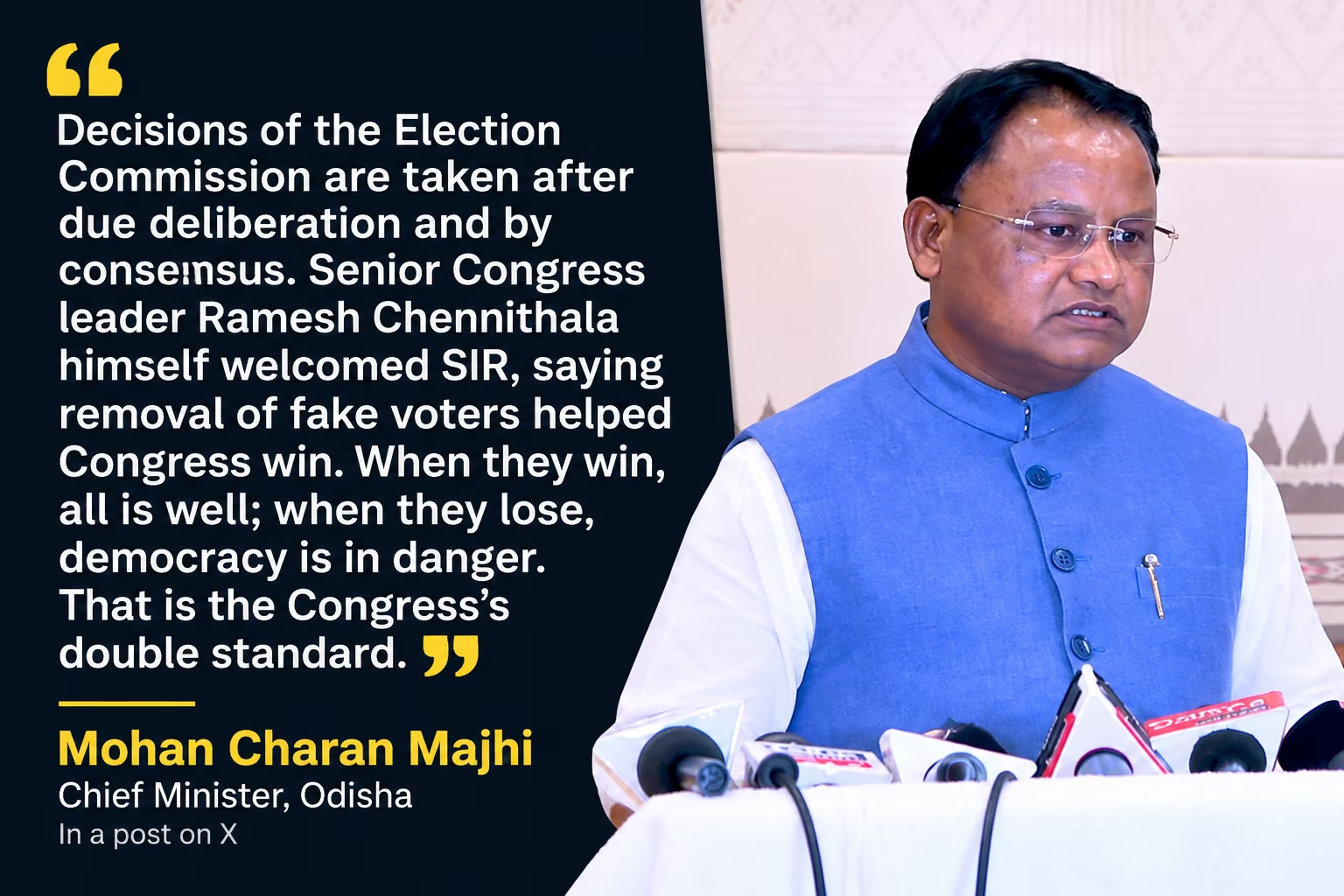
The political debate has now reached Odisha as well. Chief Minister Mohan Charan Majhi has come out strongly in defence of the Election Commission and the SIR exercise.
In a post on X, Majhi wrote, “The claim that the CEC takes unilateral decisions is misleading. Decisions of the Election Commission are taken after due deliberation and by consensus.” He added that senior Congress leader Ramesh Chennithala “himself welcomed SIR, saying removal of fake voters helped Congress win,” and called Congress’s stance a “double standard”: “When they win, all is well; when they lose, democracy is in danger.”
Majhi’s remarks put the Odisha BJP on the side of the Election Commission in the growing political dispute, while Opposition parties in the state have taken a different position on the SIR exercise and the demand for action against Gyanesh Kumar.
BJD president and Leader of Opposition in the Odisha Assembly Naveen Patnaik demanded the immediate resignation of Gyanesh Kumar on September 25 and called for the entire SIR process to be thoroughly revisited.
“Because of the sharp differences between election commissioners and the chief election commissioner, the CEC should immediately resign, and the whole SIR process should be thoroughly revisited,” Patnaik told reporters. He also said the BJD had opposed the SIR process from the beginning.
The Odisha Congress also joined the national protest against the CEC. Odisha Congress president Bhakta Charan Das and party workers marched in Bhubaneswar on September 25 demanding the resignation of Gyanesh Kumar. The protest was held outside the Chief Electoral Officer’s office, where police stopped the demonstrators and detained Das and several party workers.
Beyond the protests, a wider question is how the allegations are being tested.
The BJP does not govern every state in India. Karnataka is governed by the Congress, while Punjab is governed by the Aam Aadmi Party. These states provide different political settings in which allegations about electoral-roll manipulation can also be examined.
That does not by itself prove that the allegations are false. State governments do not control the Election Commission, and having a non-BJP government in a state cannot automatically prevent electoral irregularities or establish that none occurred.
But if “vote chori” is being presented as a systematic manipulation of elections to benefit the BJP, the evidence needs to be examined across different political environments, including states where the BJP is not in power.
The same standard should apply everywhere: whether eligible voters were removed, whether complaints were properly examined, whether additions and deletions followed the prescribed procedure, and whether the available electoral data supports the political claims being made.
For voters, the issue is ultimately more important than the political language surrounding it. The electoral process must protect every eligible citizen’s place on the voter list while providing a clear and lawful mechanism for correcting genuine errors.
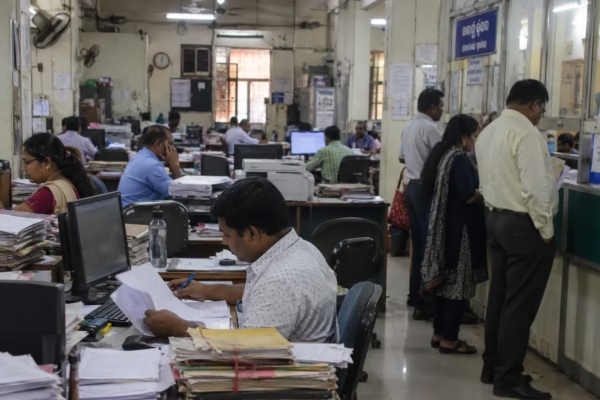
The Election Commission has also introduced doorstep document collection for voters who receive notices during SIR because their records are unmapped or show logical discrepancies. Booth Level Officers will visit such voters, collect the required documents and upload them for consideration by the Electoral Registration Officer.
Whatever the outcome of the political fight, the test for an ordinary voter is practical: is my name on the roll, and if there is a mistake, can I correct it in time? The “vote chori” allegations and the Commission’s defence should both be tested against the actual changes made to the rolls, whichever party governs the state.