




September 28 marks the 119th birth anniversary of Bhagat Singh, one of the most remembered young revolutionaries of India’s freedom struggle. But one of the clearest windows into his thinking came just a day before his death, when he wrote his last letter to his comrades from Lahore Central Jail.
On March 22, 1931, Bhagat Singh was 23 years old and knew that his execution was near. The next day, he would be hanged along with Shivaram Rajguru and Sukhdev Thapar. His letter spoke about his desire to live, his unfinished work, his commitment to the country and humanity, and the meaning he attached to his sacrifice.
Bhagat Singh was born on September 28, 1907, in Banga village in the Lyallpur district of Punjab, then part of British India and now in Pakistan. He grew up in a family closely connected with the freedom movement. His father, Kishan Singh, and uncle Ajit Singh were involved in political activities against British rule.
He received his early education in his village and later studied in Lahore at the Dayanand Anglo-Vedic School and National College. His years as a student developed his interest in history, politics, literature and revolutionary thought. He read widely and became a writer and thinker alongside his revolutionary activities.
The Jallianwala Bagh massacre of 1919 deeply affected him. As he grew older, he became involved with youth and revolutionary organisations. He helped establish the Naujawan Bharat Sabha and later became associated with the Hindustan Socialist Republican Association.
His revolutionary activities brought him into direct conflict with the British authorities. In 1928, British police officer J.P. Saunders was killed in Lahore in an action in which Bhagat Singh and his associates had intended to target police officer J.A. Scott. The incident followed the police lathi-charge on Lala Lajpat Rai during a protest against the Simon Commission.
In April 1929, Bhagat Singh and Batukeshwar Dutt threw bombs inside the Central Legislative Assembly in Delhi. The bombs were intended to make noise rather than cause deaths, and the action was meant as a political protest. Bhagat Singh later explained its purpose with the phrase “to make the deaf hear.” The two did not flee after the incident and allowed themselves to be arrested.
During his imprisonment and trial, he continued to read and write. His prison writings reveal a young man deeply engaged with questions of freedom, society, exploitation, equality and political change, and concerned about how ordinary people lived.
Once in custody, he was tried in the Lahore Conspiracy Case in connection with the Saunders killing. On October 7, 1930, he was sentenced to death along with Rajguru and Sukhdev.
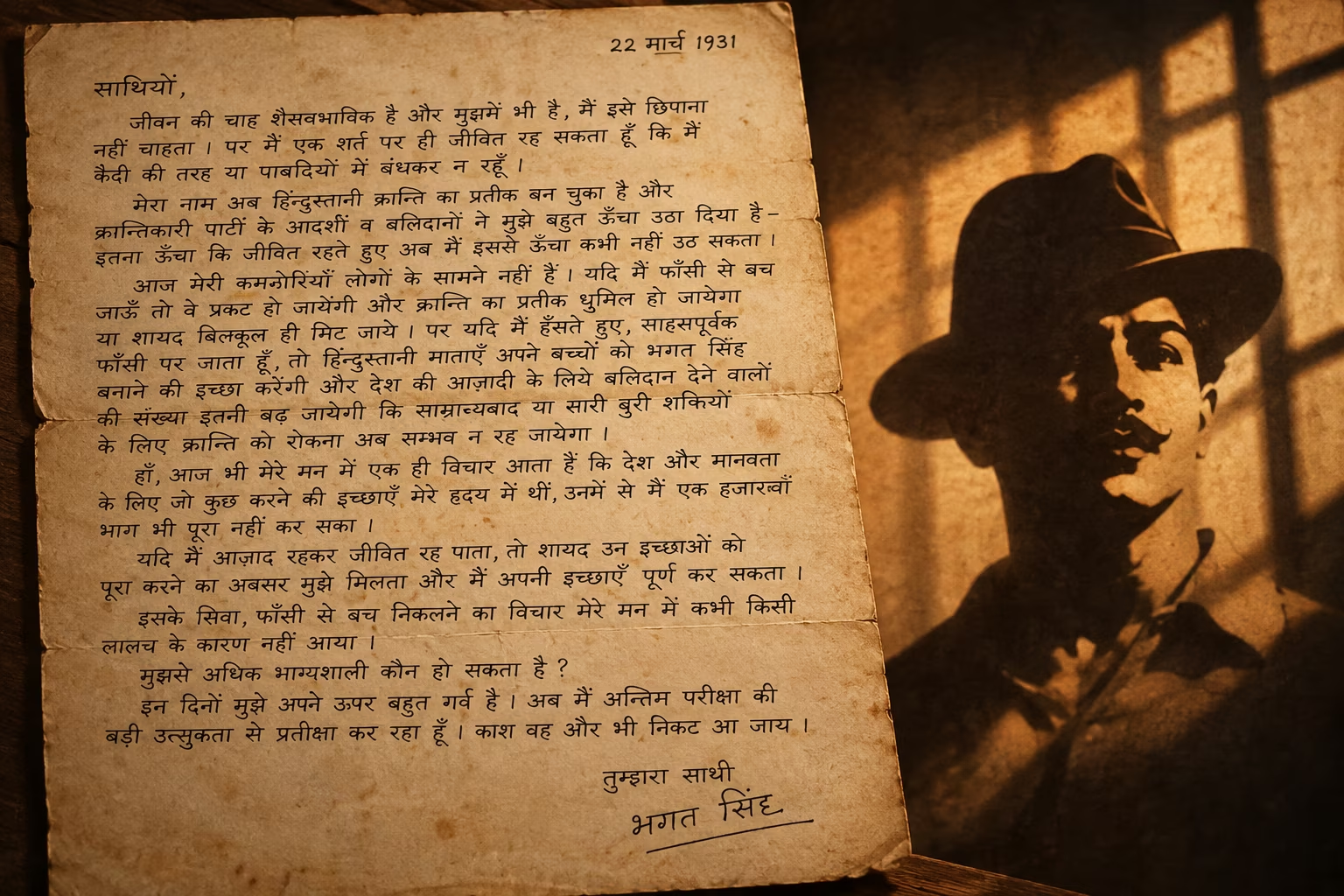
On March 22, 1931, one day before his execution, Bhagat Singh wrote his last letter to his comrades.
Bhagat Singh’s Last Letter to His Comrades
March 22, 1931
The original letter was written in Urdu. The English translation below has been prepared for this article from the Hindi text published by the Marxists Internet Archive. Different translations can use slightly different wording.
Comrades,
It is natural that the desire to live should be in me too, I do not want to hide it. But I can remain alive on one condition, that I do not want to live as a prisoner or bound by restrictions.
My name has already become a symbol of the Hindustani revolution and the ideals and sacrifices of the revolutionary party have raised me very high — so high that while remaining alive, I can never rise higher than this.
Today my weaknesses are not before the people. If I escape from the gallows, they will become apparent and the symbol of the revolution will become dim or perhaps disappear altogether. But if I go to the gallows courageously, laughing as I go, Hindustani mothers will wish for their children to become Bhagat Singhs, and the number of those who are ready to make sacrifices for the freedom of the country will increase so much that stopping the revolution will no longer be within the power of imperialism or all the evil forces.
Yes, one thought still comes to my mind today: whatever desires I had in my heart to do something for the country and humanity, I could not fulfil even a thousandth part of them.
If I could have remained free and alive, then perhaps I would have received the opportunity to fulfil them and I could have fulfilled my desires.
Apart from this, the thought of escaping from the gallows has never come to my mind out of any greed.
Who could be more fortunate than me?
These days I am very proud of myself. Now I am waiting very eagerly for the final examination. I wish that it would come even closer.
Your comrade — Bhagat Singh
A note on the Marxists Internet Archive page says the original letter ends there and that its last letters are unclear.
The letter’s central argument is that his life had become a symbol, and that escaping the gallows could dim it. He wrote that going to the gallows courageously would inspire others to take up the cause.
His final days also included another important appeal. On March 20, Bhagat Singh, Rajguru and Sukhdev wrote to the Governor of Punjab asking to be treated as prisoners of war and shot by firing squad rather than hanged. The request was not granted.
On the evening of March 23, 1931, they were hanged at Lahore Central Jail, ahead of the date formally fixed for their execution. They went to the gallows raising the slogan “Inquilab Zindabad” — “Long Live the Revolution.”
The country has changed completely since 1931. Young Indians today grow up in an independent country with opportunities in education, science and technology that Bhagat Singh’s generation could not have imagined. Serving the country now can mean building something useful, doing honest work, learning seriously and protecting the dignity of fellow citizens.
Bhagat Singh wanted to live. He wrote that he had not done even a thousandth part of what he hoped to do for the country and humanity, and still chose to face the gallows. What his last letter offers young Indians is a question rather than a script: what will you do with the life you have?