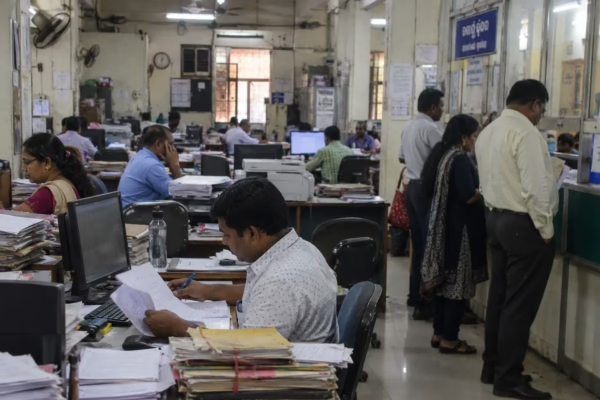





India’s real GDP grew 7.8% in the April–June 2026 quarter, according to Reuters’ report on August 31, citing government data. The growth was supported by private investment, consumer spending and manufacturing activity. But behind the national figure is a more familiar question: how much of this growth is improving the financial position of ordinary households?
When I moved to Bengaluru for work, I began looking at salary and expenses differently. Before moving, a salary can appear to offer financial independence. After moving, the calculation becomes more practical. The monthly budget is quickly divided between accommodation, meals, travel, phone bills and other responsibilities. Most of my salary goes towards meeting these regular needs, leaving less room to think about savings or unexpected expenses. The experience changed how I understand income growth. Earning money and having enough left over are two different situations.
So I keep asking: if India’s economy is growing, why does managing a household budget still feel difficult for so many people?
The pressure becomes visible in the cost of essential goods. A report published by The Times of India on July 28 highlighted rising prices in Odisha’s local markets. Mustard oil had crossed ₹190 a litre, while wholesale rice prices had reportedly increased by ₹500–700 per quintal. That report is from July; I have not seen a newer one. Even so, the figures reflect the kind of price movement that can force families to reconsider how they manage their monthly purchases.
Rice, cooking oil and vegetables are part of regular household consumption. When their prices rise, families either spend more or make adjustments elsewhere. Someone may choose a less expensive product, reduce the quantity purchased or delay another payment. A few such decisions over the course of a month can put pressure on a budget that was already limited.
CRISIL Intelligence’s June 2026 estimates showed that the cost of a vegetarian thali increased by 5% year-on-year, while a non-vegetarian thali rose by 6%. The report also recorded an increase in tomato prices from ₹32 to ₹42 per kilogram, a rise of around 31%. These figures are national estimates rather than a direct measurement of Odisha’s markets, but they show how the cost of a routine meal can change.
India’s retail inflation stood at 4.82% in August 2026, while food inflation reached 5.95%, according to the Ministry of Statistics and Programme Implementation. A national inflation figure gives an overall direction, but it does not affect every household in the same way. Families that spend most of their income on groceries and other necessities have less protection when food prices increase.
For such households, inflation can mean putting off a purchase, changing a familiar brand or using savings meant for another purpose. The decision may not look significant from outside, but it can influence whether there is enough money left for medicine or an unexpected bill.
My experience in Bengaluru made this calculation more visible. A salary may look reasonable when viewed on paper, yet the amount remaining after the monthly commitments can be surprisingly small. The pressure is not always caused by one expensive purchase. It comes from the steady accumulation of ordinary payments that cannot easily be avoided.
The situation becomes harder for workers who send money to their families. Someone living in a city may be paying for a room, preparing meals, travelling to work and supporting parents or relatives in another town. A regular salary provides some stability, but it does not guarantee that a worker will be able to build savings.
An unexpected expense can turn serious here. A medical bill or a family emergency can disturb the entire month’s plan. If there is no emergency fund, borrowing may become the only immediate option.
Figures reported by India Today in September 2026 showed that households owed around ₹32 for every ₹100 held in financial savings, compared with ₹27 four years earlier. The increase points to the growing role of borrowing in household finances. Loans can help people pay for education, housing, medical treatment or other important needs, but repayment obligations also reduce the money available for daily expenses.
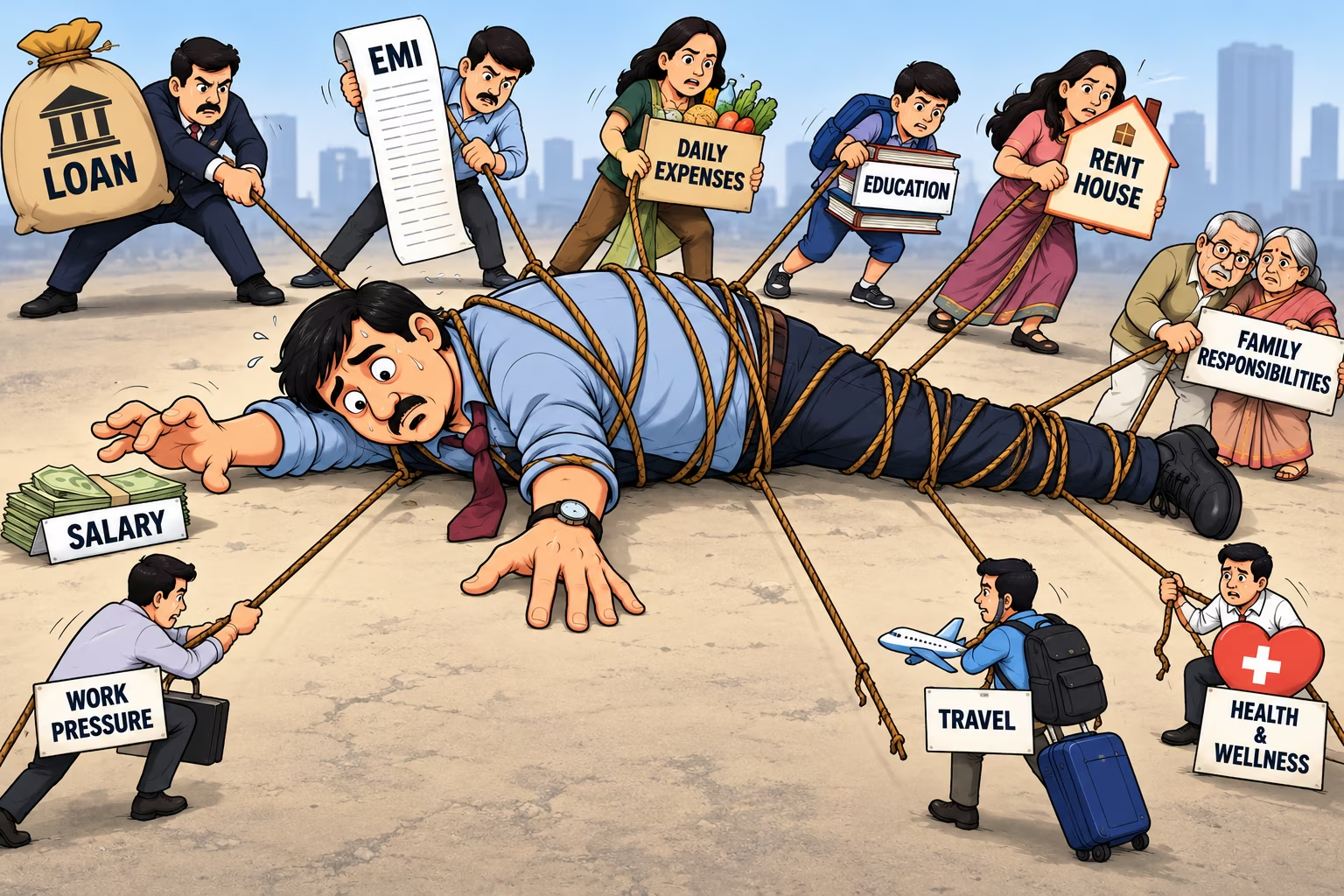
A person may receive a salary every month and still struggle to save because a fixed amount is already committed to loan repayments. When prices rise, the household has fewer choices. The problem is not necessarily a lack of income alone. It is the limited space remaining after the necessary payments have been made.
The Periodic Labour Force Survey offers another part of the picture. In the official quarterly bulletin for April–June 2026, urban regular employment was 49.3%, up from 48.9% in January–March, but almost unchanged from 49.4% a year ago. Urban unemployment for people aged 15 years and above remained broadly stable at 6.7%.
Regular wage or salaried employment can make income more predictable than irregular work. However, a predictable salary does not automatically mean that a person is financially secure. The outcome depends on the size of the income and the demands placed on it. A worker may have a job and still find it difficult to build savings, especially when supporting family members or paying off debt.
People who move to major cities in search of better opportunities face another calculation. Migration is often driven by the hope of earning more and creating a stronger future for the family. Yet the financial benefit depends on how much of the salary survives after the cost of living is paid. If a large part of the income disappears before the month is halfway through, the improvement may not feel as meaningful as expected.
Oil prices add another layer of uncertainty. On September 15, Reuters reported that Brent crude rose nearly 2% to around $107.7 a barrel after attacks on Saudi Arabian energy infrastructure. The report also said the Indian rupee weakened 0.4% to ₹95.92 against the US dollar, raising concerns for oil-importing countries such as India.
Higher crude prices can affect transport operators, delivery services and businesses that depend on moving goods. Some of those increases may eventually reach consumers. The effect does not always appear as one dramatic rise in a household bill. It can be spread across several products and services.
For a daily commuter, travel is already a regular expense. When fares or fuel-related costs increase, the extra amount has to be paid from the same monthly income. A worker who is already spending heavily on accommodation may have little flexibility to absorb it.
The cost of living needs a place in discussions about employment and investment. A new job is valuable, but its practical benefit also depends on where it is located, how much it pays and what the worker must spend to reach it. A salary cannot be viewed separately from those conditions.
Housing is one of the clearest examples. Workers who cannot afford to live close to their workplaces may choose cheaper accommodation farther away. That decision can reduce rent in one direction while increasing travel time and commuting costs in another. It can also leave less time for rest and family.
Public transport and affordable housing should be treated as part of the employment question. They are not separate urban concerns when a large portion of a worker’s income is spent simply reaching a job or maintaining a place to live.
Odisha’s investment outreach also needs to be examined through the question of actual employment. During the UAE outreach, the state reported proposed investments worth ₹2,43,162 crore with the potential to create 6,18,725 jobs. These figures describe proposed investment and projected employment, not jobs that have already been created.
The real test will come during implementation. Projects must move from announcements to construction, production and recruitment. Their value for households will depend on whether they create stable employment, support local businesses and offer opportunities to people who currently leave Odisha in search of work.
For Odisha, employment closer to home could change the financial position of many families. A worker who migrates may earn a salary but also face the cost of living away from relatives. If suitable jobs are available locally, families may be able to reduce some of those expenses and keep more of their income within the local economy.
The same concern extends across India. Economic growth can increase production, investment and employment, but people experience the results through their monthly income and expenses. They notice whether groceries have become more expensive, whether travelling to work costs more and whether anything remains to be saved after the bills are paid.
India’s growth story deserves attention, but household finances deserve the same seriousness. Investment announcements, GDP figures and employment data become more meaningful when they lead to dependable earnings and greater financial stability. For a worker, the result is not measured only by receiving a salary. It is also seen in whether that person can manage an emergency without immediately turning to debt.
At the end of the month, the reality is often simple: a person checks the account balance after paying everything that cannot be avoided. Whatever remains determines whether the next month begins with some confidence or another round of calculations.