


India’s first human spaceflight programme is moving into a crucial phase, with ISRO now targeting the first uncrewed Gaganyaan mission for later this year.
ISRO Chairman V Narayanan said on September 4 that work on the mission is progressing “vigorously and systematically” and that the space agency, along with industry and other organisations, is preparing for the launch during the current calendar year. The announcement came shortly after ISRO successfully launched the EOS-05 Earth observation satellite from Sriharikota.
The Gaganyaan programme is not a single launch. Before Indian astronauts are sent into orbit, ISRO plans three uncrewed missions to test the systems needed to keep a crew safe during launch, spaceflight and the return to Earth.
The first of those missions, known as G1, is now the immediate focus.
The Government had already told Parliament in August that the first uncrewed experimental flight carrying Vyommitra, ISRO’s humanoid robot, is targeted for the fourth quarter of 2026. Two more uncrewed missions are planned before the first crewed flight.
That cautious approach reflects the difference between sending a satellite into space and sending people.
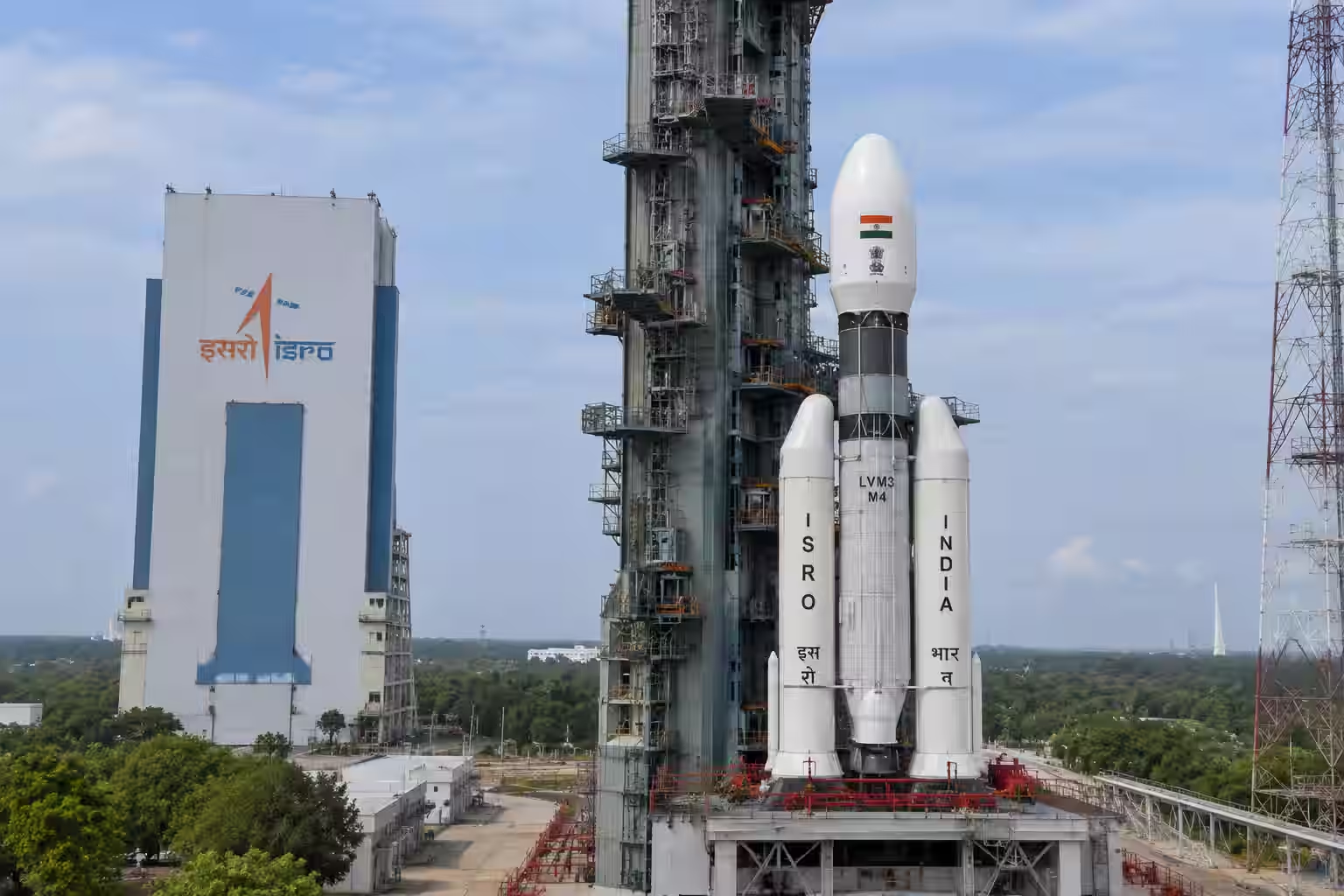
Gaganyaan will use a human-rated version of the LVM3 rocket, known as the Human Rated Launch Vehicle Mark-3 or HLVM3. The rocket has been modified and tested with human safety in mind, including the addition of a Crew Escape System designed to pull the crew module away from the rocket if something goes wrong during launch or ascent.
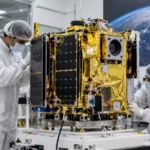
The spacecraft itself consists of a Crew Module, where astronauts will live during the mission, and a Service Module that provides propulsion and other essential systems. ISRO says the mission is designed to take the crew module to a low-Earth orbit of about 400 kilometres before bringing it safely back for a splashdown at sea. Much of the work now happening is therefore invisible to the public.
ISRO has spent months testing individual systems rather than rushing towards a launch date. The agency recently completed a major integrated main parachute air-drop test in Madhya Pradesh, simulating the loads expected during the first uncrewed Gaganyaan flight. The Crew Module’s deceleration system uses 10 parachutes of four different types to slow the spacecraft before splashdown.
In July, ISRO also completed several qualification tests involving the Crew Module, including testing its system for remaining upright after landing in the sea. The agency has been conducting similar tests across propulsion, avionics, structures, escape systems and recovery operations.
The rocket is receiving the same level of scrutiny.
ISRO said in July that the CE20 cryogenic engine intended for an upcoming LVM3 mission had successfully completed a flight acceptance hot test. The engine has already met human-rating requirements for use in Gaganyaan missions.
The first uncrewed flight will bring these separate pieces together. The vyommitra will fly as an experimental payload during G1, helping ISRO validate systems in an actual spaceflight environment before astronauts are placed inside the spacecraft. The mission will also provide an important opportunity to assess how the vehicle, crew module, life-support-related systems, communications, navigation and recovery arrangements perform as an integrated system.
ISRO’s own programme documents describe G1 as an early flight test of the various systems, followed by two additional uncrewed missions in the configuration of the eventual crewed flight.
There is still no reason to treat the end-of-2026 target as a guaranteed launch date.
Human spaceflight programmes are built around safety margins, and ISRO has repeatedly stressed that systems must be qualified before people fly. Narayanan said around 8,000 tests had been completed so far, while three uncrewed missions are planned before the crewed mission.
That sequence is deliberate.
The Gaganyaan programme has also grown into something larger than India’s first astronaut flight. The government has outlined plans for a Bharatiya Antariksh Station, with the first module targeted as part of a longer human-spaceflight roadmap. The experience gained from Gaganyaan is expected to form the foundation for India’s future work in low-Earth orbit and longer-duration human missions.
For now, however, everything comes back to G1.
The first uncrewed launch will not put an Indian astronaut into space. It will do something just as important: give ISRO real flight data before a human life depends on the system.
After years of design, testing and preparation, India’s human spaceflight programme is approaching the point where its most important test will no longer happen only on the ground.