





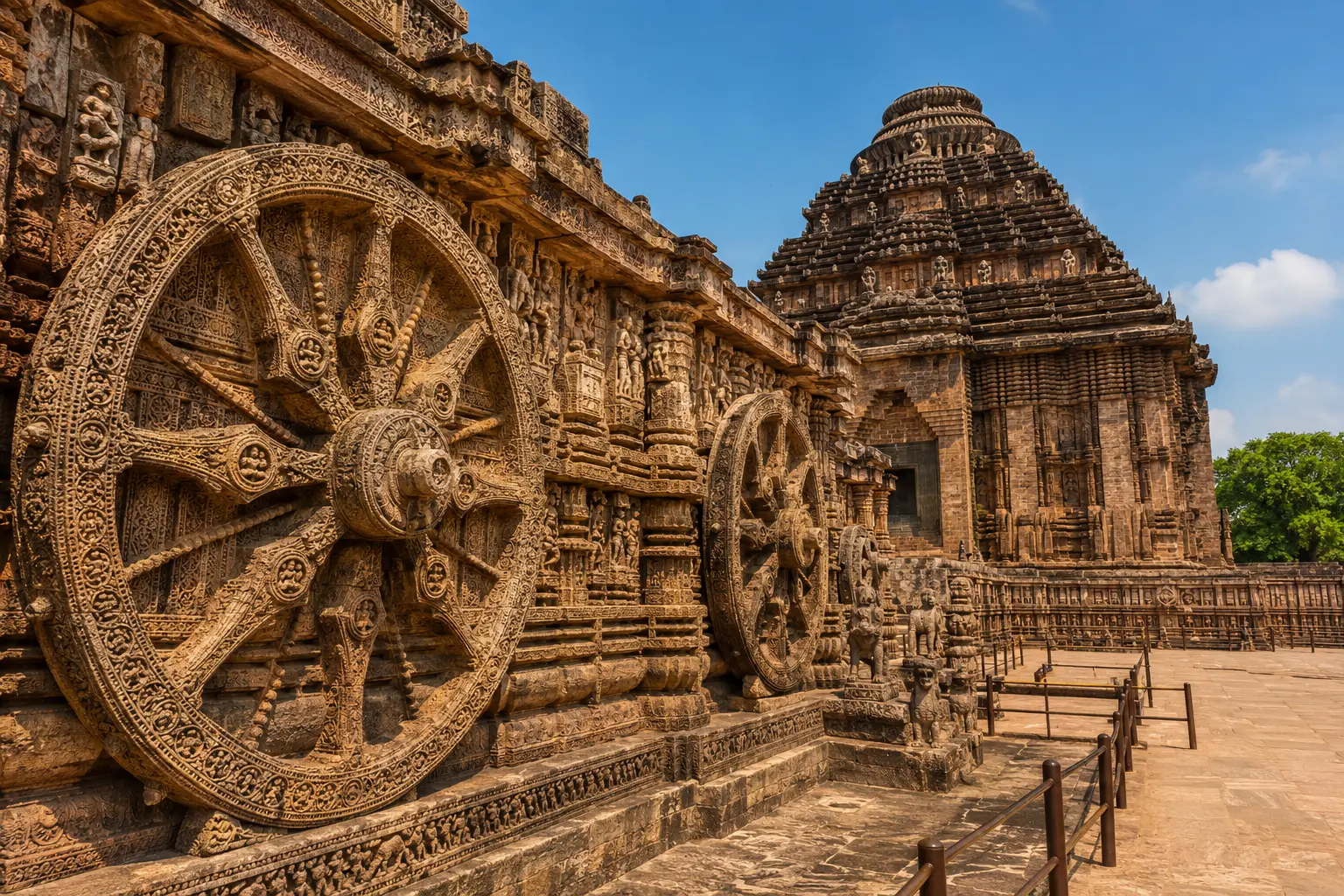
Konark, Odisha: As you walk towards the Konark Sun Temple, the first thing that stands out is the stone. Then come the details.
A wheel nearly three metres across carries rows of carvings. A musician appears on one wall, a dancer on another. Animals, floral patterns, figures from religious traditions and scenes from everyday life cover parts of the monument. The closer you look, the more the temple begins to feel less like a collection of ruins and more like a record of the people and culture that created it.
Built in the 13th century during the reign of Eastern Ganga king Narasimha Deva I, Konark was conceived as the monumental chariot of Surya, the Sun God. UNESCO describes it as one of the finest expressions of Kalingan temple architecture and an exceptional testimony to the 13th-century kingdom of Orissa.
The idea behind the temple is visible throughout the site. Its design includes 24 carved wheels, arranged as 12 pairs, with detailed motifs connected with the passage of seasons and months. The chariot was also represented with horses drawing it across the heavens. What looks at first like an enormous architectural structure is therefore also a carefully planned expression of the movement of the Sun.
But Konark is not only about its size or symbolism. Its carvings are where much of its cultural story survives.
Between the wheels and across the temple’s platforms are sculptures of musicians, dancers, animals and people. They offer glimpses into the artistic imagination and social life of medieval Odisha. The Nata Mandir, or dance hall, stands within the complex and carries further carvings connected with dance and music. The monument brings together religion, art and everyday life in a way that makes its history visible rather than simply recorded in words.
The temple that stands here today, however, is not the complete monument that was built centuries ago. The main sanctuary once had a towering structure above it, but that tower was lost in the 19th century. The Jagamohana, or audience hall, remains the most prominent surviving structure, while the roofless Nata Mandir and other remains help visitors understand the scale of the original complex.
That missing part is important when looking at Konark today. What we see is a monument shaped both by the ambition of its builders and by centuries of change, damage and conservation. Around it, many stories have developed about its construction and decline. Some belong to local tradition and legend; others are supported by historical or archaeological evidence. Keeping those two apart is important when telling the story of a monument this old.
What remains beyond doubt is the skill of the craftsmen who created it. The scale of the architecture, the precision of the carvings and the variety of subjects represented in stone show the cultural confidence of the Ganga period. Konark was not built simply to be seen from a distance. Its details were meant to be discovered.
That is still happening today.
Visitors walk around the wheels, stop before the sculptures and look closely at stones carved hundreds of years ago. A monument built for the worship of the Sun has become, over time, a way of seeing the history of Odisha itself, its architecture, artistic traditions, religious life and connection with the wider cultural history of India.
Konark was inscribed on the UNESCO World Heritage List in 1984. UNESCO recognises it for its architectural achievement, its testimony to the 13th-century kingdom of Orissa and its connection with the history of Surya worship.
Today, the temple no longer stands in the form its builders once imagined. Yet enough remains to understand the ambition behind it.
Stand beside one of those stone wheels and look closely. The history of Konark is not somewhere hidden in a book. Much of it is right there carved into the stone, shaped by the hands of craftsmen who lived centuries ago, and still visible to anyone willing to stop and look.