



Sambalpur: For people in western Odisha, the demand for a second AIIMS has never been only about another hospital. It is also about access to specialised healthcare and the long journeys many patients and their families face when they need advanced treatment.
Now, nearly two years after Chief Minister Mohan Charan Majhi announced that Odisha’s second AIIMS would come up in Sambalpur, the issue has returned to the centre of public and political discussion.
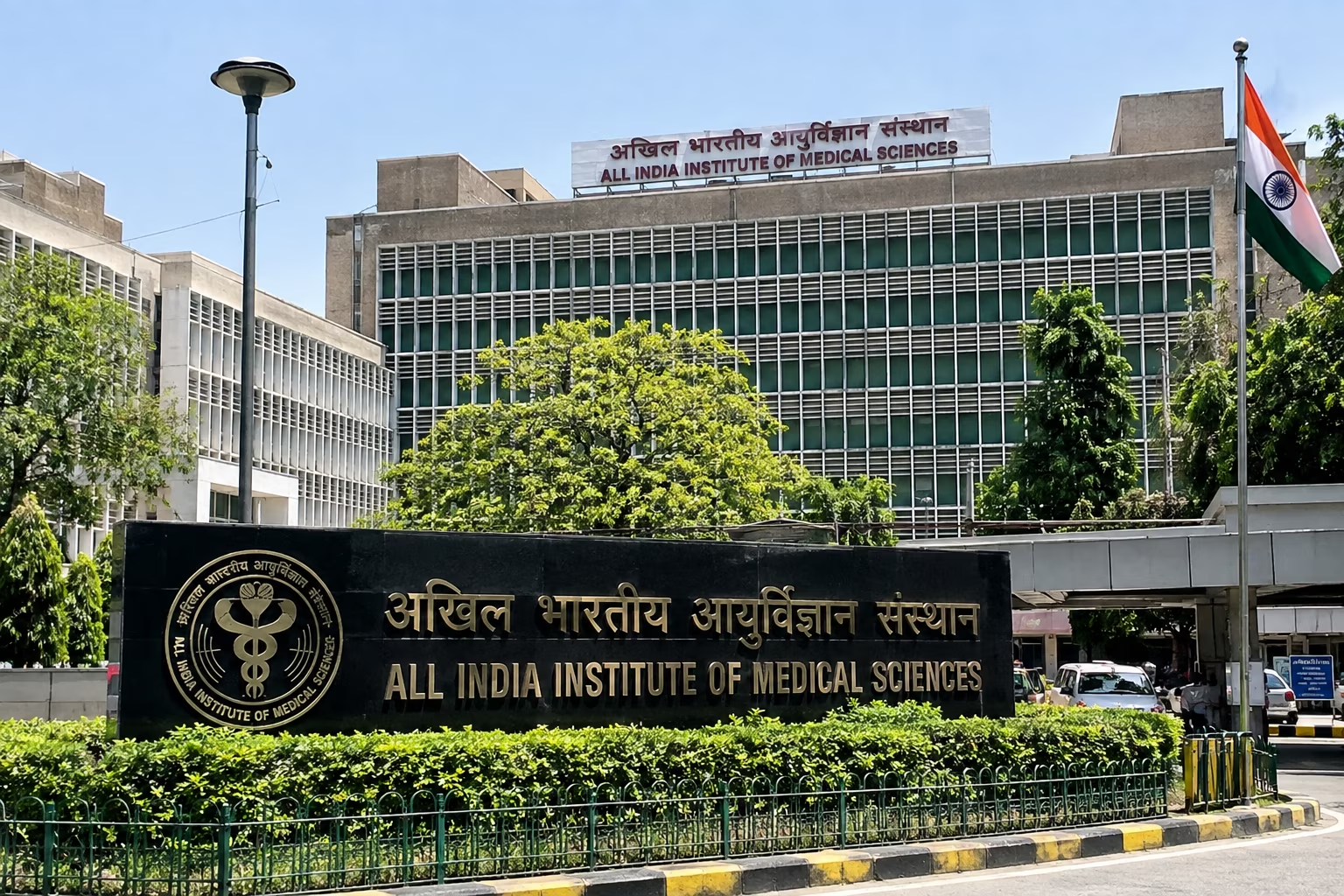
According to a July 29, 2026 report, Union Minister of State for Health and Family Welfare Prataprao Jadhav told the Rajya Sabha that there was no proposal to establish a second AIIMS in Sambalpur or elsewhere in Odisha. The response was reported to have been given to a question raised by BJD MP Manas Ranjan Mangaraj. The Centre also referred to the existing AIIMS Bhubaneswar and its satellite centre in Balasore.
The response has brought back questions about what happened to the proposal announced by the Odisha government in 2024.
Soon after the BJP government came to power in Odisha, the state began pushing for another AIIMS in western Odisha. In June 2024, Deputy Chief Minister K.V. Singh Deo raised the demand at a pre-Budget meeting, arguing that another major medical institution was needed to improve access to specialised healthcare in the western part of the state.
On June 29, 2024, Chief Minister Mohan Charan Majhi met Union Health Minister J.P. Nadda in New Delhi and discussed several issues concerning Odisha, including the opening of a second AIIMS in Sambalpur and expansion of AIIMS Bhubaneswar.
The proposal received greater public attention in September. On September 8, 2024, during a Nuakhai programme in Sambalpur, Majhi announced that Odisha’s second AIIMS would come up in the city. The announcement created expectations that the long-standing demand for a major central medical institution in western Odisha was moving towards implementation.
But the process had not reached that stage.
A September 2024 report said the Odisha government was looking for suitable land for the proposed AIIMS in Sambalpur. Basantpur near IIM Sambalpur and Majhipali were among the locations being considered, while connectivity and availability of water were among the factors being examined. The report also said the Centre had not yet given its green signal to the proposal.
A state government announcement or proposal does not by itself amount to approval of an AIIMS by the Union government. An institution of this scale requires a formal decision, funding, land and a long process of construction and staffing.
The issue continued to feature in political statements even after the 2024 announcement.
In February 2026, BJP national spokesperson Ajay Alok spoke in Sambalpur about the proposed AIIMS and said the process of identifying land was underway. The statement kept the project in the public discussion, particularly among people who had been waiting for movement on the proposal.
Opposition leaders in Sambalpur questioned the status of the project. BJD leaders sought clarity on whether there was a formal provision and approval for the proposed institute. Those exchanges reflected the continuing political disagreement over the project rather than proof that construction had received final approval.
The latest reported response from the Centre has added a new layer to that debate. The July 2026 account said the Union government pointed to AIIMS Bhubaneswar and its satellite centre in Balasore while stating that there was no current proposal for another AIIMS in Odisha. The Centre also referred to other healthcare projects in the state, including a 150-bed Critical Care Hospital Block at AIIMS Bhubaneswar.
The demand for another AIIMS in Odisha, however, is much older than the present political dispute.
In July 2024, a Rajya Sabha discussion also recorded a demand for full-fledged AIIMS institutions in Sambalpur, Koraput and Balasore. The demand was linked to the need for better access to specialised healthcare across the state.
Parliamentary records show that Odisha has been seeking another AIIMS for years. In August 2022, the Union government told the Rajya Sabha that Odisha had requested a second AIIMS at Sundargarh but that there was no proposal for establishing another AIIMS in the state under the Pradhan Mantri Swasthya Suraksha Yojana.
The Centre had taken a similar position earlier. An official parliamentary reply from November 2019 stated that AIIMS Bhubaneswar was already functional and that there was no proposal at that time to establish another AIIMS in Odisha.
For patients in western Odisha, however, the debate is much more practical than the political statements surrounding it.
When specialised treatment is unavailable nearby, families may have to travel to Bhubaneswar, Cuttack or even outside the state. For a serious illness, that can mean repeated journeys, accommodation costs, lost working days and the added pressure of arranging treatment far from home.
A major AIIMS in Sambalpur could potentially change that situation by bringing advanced medical services and specialist care closer to people in western Odisha. But those benefits can only become real after the project receives approval, land is finalised, funding is allocated and the institution is actually built and staffed.
The latest reported Centre response has renewed questions about the status of the Sambalpur project. The state government announced the proposed institute in 2024, while subsequent statements kept the project alive in public discussion. The July 2026 report, however, indicates that the Union government had no current proposal for another AIIMS in Odisha at that time.
Now the timeline contains several different stages: a demand from Odisha, discussions between the state and Centre, the Chief Minister’s 2024 announcement, efforts to identify land, later political statements about the project and the reported position from the Union government.
People’s in Sambalpur and across western Odisha, the central question remains whether the proposal will eventually move beyond announcements and political assurances and become an approved medical institution.
That is the gap between a promise and a hospital and Sambalpur is still waiting to see what comes next.