



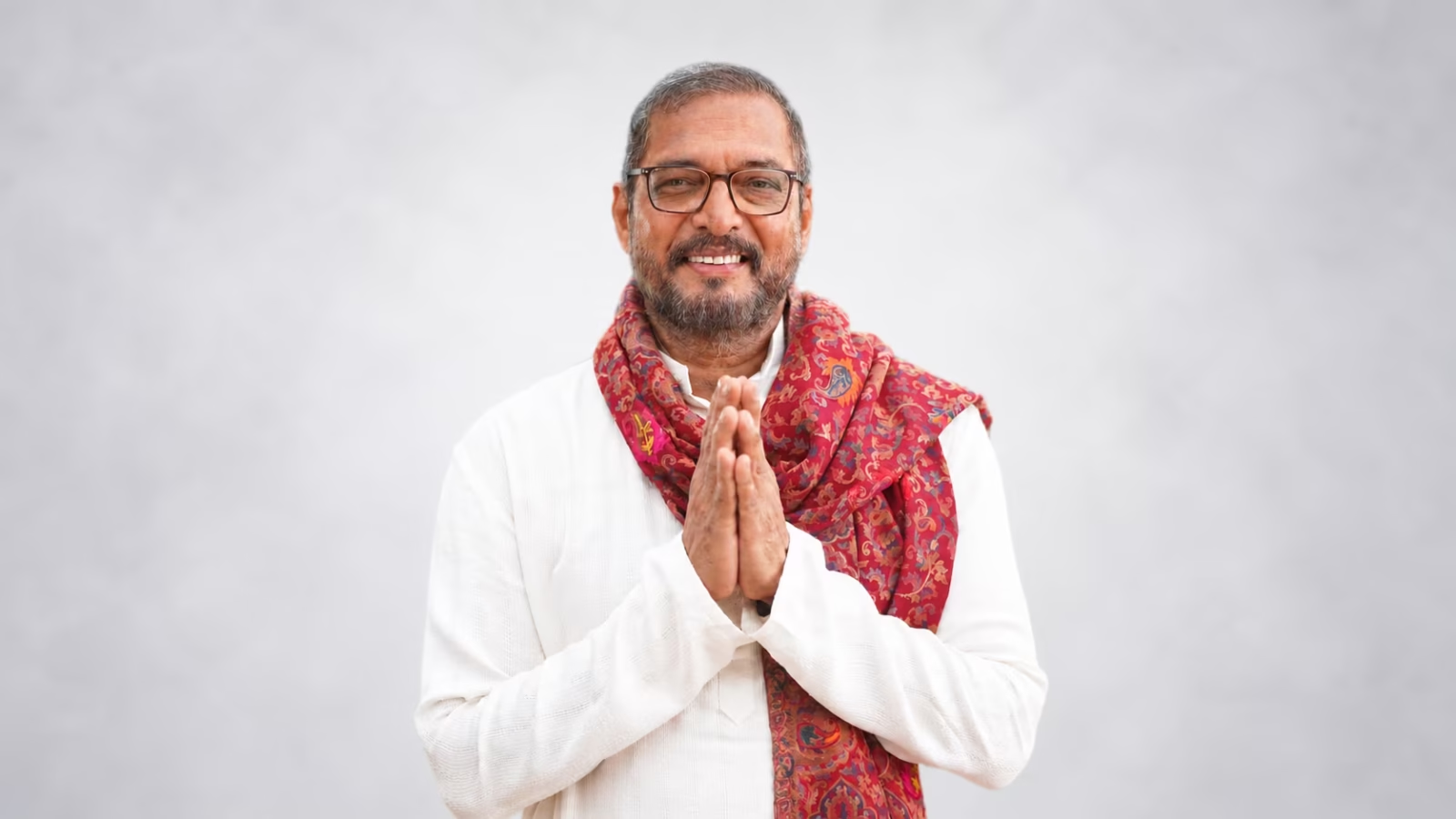
Veteran actor Nana Patekar passed away in the early hours of October 8, 2026, at the age of 75, bringing an end to a career that stretched across nearly five decades.
He suffered a cardiac arrest at his residence in Dona Paula, Goa, was found unconscious and taken to a private hospital, where doctors attempted to revive him for around 45 minutes. He could not be revived. His son, Malhar Patekar, confirmed the news.
For millions of Indians, his passing means the loss of a familiar voice. Nana Patekar had a way of delivering a dialogue that could make a scene feel larger than the film itself. His performances could be angry, vulnerable, humorous, frightening or deeply emotional. At different points in his career, he became both a respected performer of serious cinema and a hugely popular comic actor.
But his story cannot be understood only through the films he made. It began much earlier, during years when survival was a bigger concern than cinema.
Born Vishwanath Patekar on January 1, 1951, in Maharashtra, Nana grew up during difficult financial circumstances. He began working while still a teenager and later recalled earning around ₹35 a month painting film posters. He also spoke about walking long distances to work and sometimes surviving on one meal a day.
Those years left a permanent mark on him. He later spoke about poverty with an honesty that was unusual for someone who had spent decades among India’s biggest film stars. The struggle also helped shape the toughness and realism that audiences would later recognise in his acting.
He studied at Mumbai’s Sir J.J. Institute of Applied Art and worked in advertising before moving more seriously towards theatre. Acting gradually became his chosen path, taking him from the stage to Marathi cinema and eventually to some of the biggest Hindi films of his generation.
His film career began with Gaman in 1978. Success did not come overnight. He built his reputation through challenging roles and strong performances before Parinda brought him major national recognition.
His performance in Parinda earned him the National Film Award for Best Supporting Actor. He later won the National Film Award for Best Actor for Krantiveer and another Best Supporting Actor award for Agni Sakshi. In 2013, he was honoured with the Padma Shri for his contribution to cinema and the arts.
Films such as Prahaar: The Final Attack, Angaar, Tirangaa, Khamoshi: The Musical, Apaharan, Ab Tak Chhappan and Natsamrat showed different sides of his ability. He could play a police officer, soldier, criminal, politician, father, troubled artist or ordinary man without making one character feel like a repetition of another.
His connection with theatre remained an important part of his identity. That foundation could often be seen in the control of his voice and expressions. He did not need elaborate gestures to dominate a scene. A pause, a look or a change in tone could be enough.
Then came Welcome.
As Uday Shetty, Nana Patekar showed another side of himself. The same actor known for intense dramas and powerful monologues became a comic favourite for a completely different generation. His chemistry with Anil Kapoor turned their gangster characters into some of Hindi cinema’s most remembered comic figures.
The success of Welcome and his later appearances in the Housefull franchise showed that his popularity was never limited to serious cinema. He could move between drama and comedy while retaining the distinctive presence that audiences associated with him.
His later career continued to carry that range. He appeared in Housefull 5 and remained active in 2026, including O’ Romeo and his association with Subedaar. His final years showed that cinema remained an important part of his life even after decades at the top of the industry.
Yet there was another side to Nana Patekar that became increasingly important as he grew older.
He became closely associated with rural Maharashtra and the problems faced by farmers. In 2015, he and actor Makarand Anaspure helped establish the NAAM Foundation in response to the suffering of drought-affected farming families. The organisation went on to work in areas including water conservation, rural development and assistance to farmers.
The work mattered to him because it connected his public life with people facing problems far removed from the film industry. Farmers struggling with drought, debt and the loss of livelihoods became part of the social causes he chose to support.
NAAM Foundation has worked on water conservation, restoration of water infrastructure and development in drought-affected rural areas. For Nana, this became an important part of his life away from the cameras.
That connection with rural life also influenced the way he lived. Despite becoming a nationally recognised actor, he was often associated with a simpler lifestyle and remained closely connected to rural surroundings and farming.
Just four days before his passing, Nana made what would become his final known public appearance at the Samraat Club International installation ceremony in Dona Paula, Goa, on October 4. PTI posted video of the actor attending and addressing the gathering. Multiple news organisations subsequently reported the event and his remarks.
During the event, he spoke about former Goa Chief Minister Manohar Parrikar, whom he remembered as a friend, and reflected on how much a person can accomplish within a limited lifetime. He also spoke about the importance of contributing to society.
At one point, Patekar said he did not know whether he would be there the following day and reflected on the fact that everyone eventually has to leave this world.
Those words have naturally taken on a different meaning after his passing. But they should be remembered as part of the way Nana spoke about life, responsibility and mortality rather than presented as a prediction of what was about to happen.
News of his passing quickly brought tributes from across Indian cinema and public life.
Akshay Kumar remembered working with him in Welcome and Housefull 5, praising his distinctive voice, intensity and honesty as a performer. Riteish Deshmukh mourned the loss of an exceptional actor, while several other members of the film industry also expressed their grief.
Other members of the film industry remembered not only his acting but also his simplicity and his work away from cinema. The tributes reflected the unusual range of his career and the personal impact he had on colleagues and younger performers.
What makes Nana Patekar’s story unusual is the distance between where he started and where he eventually stood.
A boy who once earned ₹35 a month painting film posters became a National Award-winning actor. A performer known for intense characters became one of Hindi cinema’s most recognisable comic actors. A major film star maintained a strong connection with rural India and spent years supporting work for farmers and villages.
His career also crossed the boundaries between mainstream Hindi cinema, Marathi cinema and theatre. For audiences, there will be the unforgettable characters. For aspiring actors, there will be the story of someone who entered the profession without an easy path to success. For people who followed his social work, there will be another memory of a public figure who used his position to draw attention to problems far away from film sets.
At The Utkal, we believe a tribute should remember the whole person, not just the celebrity.
Nana Patekar’s story began with hardship. He worked as a teenager, studied while earning a living, entered theatre, found his place in cinema and eventually became one of India’s most respected actors.
But the story did not end with awards.
He remained connected to rural life and continued to support work for farmers, water conservation and rural development through NAAM Foundation. He also continued acting while maintaining a life that, in many ways, remained far removed from the glamour normally associated with a major film star.
That makes his legacy unusually complete.
The actor will remain in the films. The voice will remain in the dialogues. The characters will remain with the audiences. And the work he did away from the camera will remain with the people he tried to help.
India has lost one of its most distinctive voices.
Indian cinema has lost one of its most respected performers.
For us at The Utkal, this is our independent tribute to an artist whose life carried struggle, achievement, simplicity and service.
Nana Patekar will be remembered not only for the roles he played, but for the life he chose to live when the cameras were turned away.
Om Shanti.